You saw “WRU” pop up in a text and froze for a second, wondering if you missed something important or if it’s just another random string of letters your friend group loves throwing around. That tiny mix of confusion and curiosity is exactly why you’re here.
This guide breaks down the wru full form, the real wru meaning, and how it’s used across texting, DMs, and social media with actual examples, not vague definitions. By the end, you’ll never have to guess what someone means by “wru” again. Let’s get into it.
WRU Meaning in Text – Quick Explanation
Ever gotten a text that’s just three letters and felt oddly put on the spot? That’s the magic of wru meaning in modern texting: short, quick, and loaded with intent.
WRU is one of the most common texting abbreviations used across chat apps, social media, and group messages. It’s part of a bigger world of internet slang and chat lingo that people use to talk faster without sounding cold or robotic. Most of the time, it’s a casual, low-effort way to check in on someone.
- WRU most commonly stands for “where are you”
- It can occasionally mean “who are you” depending on context
- Used heavily in casual texting between friends and partners
- Common on Instagram, Snapchat, WhatsApp, and TikTok comments
- Considered a friendly, informal digital communication shortcut
What Does WRU Really Mean in Texting?
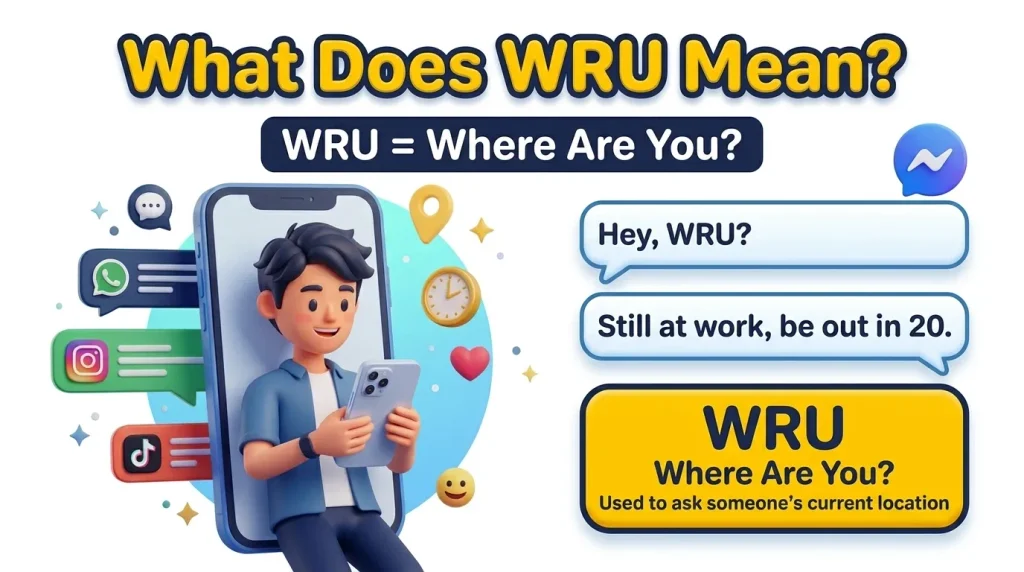
At its core, the wru full form is simple: “where are you.” It’s a quick nudge to find out someone’s location, whether that’s physically or just in the conversation. Occasionally, especially with strangers or in gaming chats, it flips to mean “who are you,” so tone and context always matter.
People rarely type it out fully because texting culture rewards speed. The shorter the message, the more natural and instant the conversation feels. That’s the entire appeal of acronym-heavy chat lingo; it mimics how we actually talk.
Example in texting: Friend 1: hey wru rn Friend 2: still at work, be out in 20
Wru full form
Curious minds want a straight answer, not a runaround so here’s the wru full form without any fluff or unnecessary detours to slow you down.
The most widely accepted wru full form is “where are you.” It’s used to ask about someone’s current location, whether you’re trying to meet up, checking if they’re safe, or just wondering why they haven’t shown up yet. In rarer cases, particularly online gaming or anonymous chats, it can shift to mean “who are you.”
- Where are you the dominant, most common meaning
- Who are you a rare secondary meaning in gaming or anonymous chats
- Falls under general texting abbreviations and internet shorthand
- Frequently paired with WYD (“what you doing”) in group chats
- Recognized across most major messaging platforms and apps
How Is WRU Used in Everyday Conversations?
| Context | Meaning of WRU | Typical Response |
| Text to a friend | Where are you | Sharing location or ETA |
| Group chat | Where are you (asking who’s missing) | “Omw” or “running late” |
| Gaming chat with stranger | Who are you | Introducing yourself |
| Instagram DM | Where are you | Sharing plans or vibe check |
Example in chat: Friend 1: wru? we’re already here lol Friend 2: 5 mins away, traffic is brutal
Wru meaning
Sometimes the letters feel obvious, but the actual wru meaning behind a message carries more emotional weight than people expect from three simple characters.
Beyond the literal definition, wru meaning often signals that someone is thinking about you or wants to reconnect. It’s rarely just about geography it’s about presence, attention, and curiosity. This is why the phrase shows up so often in relationships, close friendships, and casual flirting.
Key Points
- Location check the most literal and common use
- Emotional check-in asking without directly saying “I miss you”
- Conversation starter a low-pressure way to open a chat
- Group coordination figuring out who’s late or missing
- Flirty undertone sometimes used to test interest casually
Example Messages
- “wru?? we’ve been waiting 10 mins 😭”
- “wru rn, bored asf”
- “wru, haven’t heard from you all day”
- “hey wru, wanna facetime?”
- “wru at, still coming tonight?”
Example in texting: Friend 1: wru, you good? Friend 2: yeah just napped, my bad
Origin and Background of WRU
Every piece of internet slang has a backstory, and WRU’s rise says a lot about how texting reshaped the way we casually communicate with each other.
WRU emerged alongside early SMS culture, back when character limits and slow typing on flip phones pushed people to shorten everything possible. As texting culture evolved into smartphones and social apps, the abbreviation stuck around because it’s fast, universal, and instantly understood by most texters.
- Originated during early SMS and instant messaging eras
- Character limits on old phones encouraged shorthand like WRU
- Spread quickly through teen texting culture in the 2000s
- Carried over naturally into social media slang on newer apps
- Still relevant today despite full keyboards and voice-to-text options
Example in chat: Friend 1: remember when we used to type wru on flip phones lol Friend 2: don’t remind me, my thumbs still hurt
Real-Life Conversations Using WRU
Reading a definition is one thing, but seeing wru meaning play out in real conversations makes the whole concept click instantly and naturally.
Different platforms give WRU slightly different flavors a WhatsApp message feels different from a TikTok comment, even though the letters are identical. Below are real-style examples across the apps people use most.
- WhatsApp usually direct and location-focused
- Instagram DMs often casual or slightly flirty
- Text messages practical, used for meetups or plans
- TikTok comments playful, sometimes joking or sarcastic
- Tone shifts heavily based on platform culture and relationship
WhatsApp Conversation
Friend 1: wru? call ended and you just vanished Friend 2: sorry, bad signal, at home now
Instagram DM Example
Friend 1: wru rn, saw your story from that place Friend 2: still here, come through if you’re free
Text Message Conversation
Friend 1: wru, dinner’s getting cold Friend 2: pulling in now, 2 mins
TikTok Comment Section
Friend 1: wru bestie we need part 2 😭 Friend 2: filming it rn don’t worry
Emotional and Psychological Meaning Behind WRU
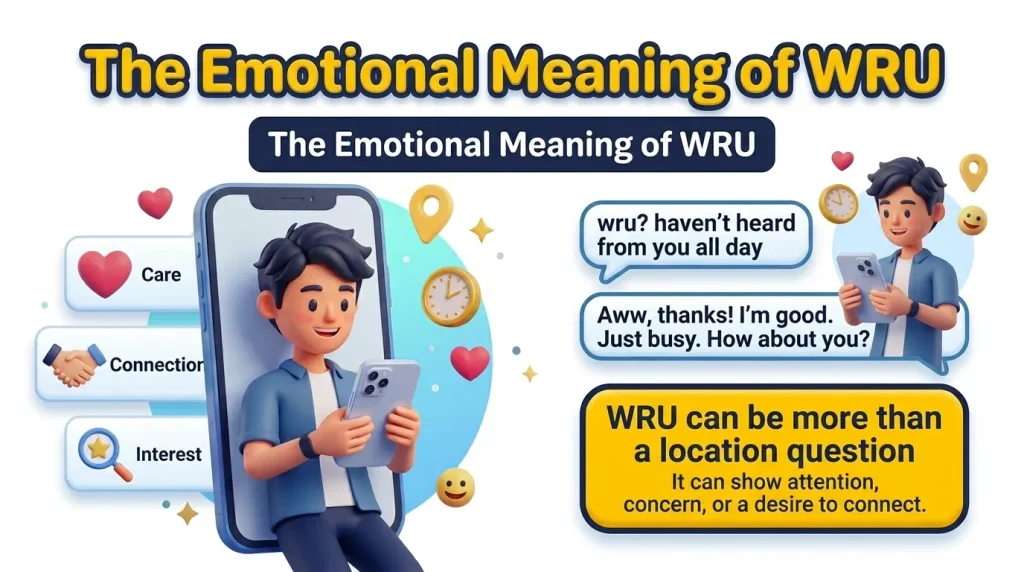
Behind every casual “wru” text is a small emotional signal, and understanding that layer changes how you read the messages you receive daily.
The wru meaning isn’t only logistical psychologically, it often reflects a desire for connection, reassurance, or simply attention. People rarely send it to someone they don’t care about checking in with.
1. Checking on Someone
- Shows genuine concern for someone’s wellbeing
- Common after a period of silence or unanswered texts
- Often sent when someone seems distant or unusually quiet
- Used by parents, partners, and close friends alike
- Signals care without sounding overly serious or dramatic
2. Showing Interest
- A subtle way to keep conversation going
- Often used early in a budding relationship or crush
- Suggests curiosity about someone’s daily routine
- Low-pressure compared to asking something more direct
- Common in flirty texting exchanges
3. Creating Connection
- Helps maintain a sense of closeness across distance
- Frequently used in long-distance friendships or relationships
- Reinforces that someone is still on your mind
- Builds a light, ongoing rhythm of daily check-ins
- Small texts like this sustain bigger relationships over time
Example in texting: Friend 1: wru, haven’t talked in a bit Friend 2: just been swamped, missed you too
How WRU Is Used in Different Contexts
Not every “wru” carries the same weight context completely changes how the message should be read and responded to.
Depending on where and who you’re texting, the wru full form shifts slightly in tone even though the letters stay the same. Recognizing the setting helps you avoid awkward misreads.
| Setting | Typical Tone | Example Use |
| Social Media | Playful, public | Comment on a story or post |
| Friends/Relationships | Warm, casual | Daily check-in texts |
| Work/Professional | Rare, informal only | Team chat among close coworkers |
| Casual vs Serious | Depends on punctuation/tone | “wru?” vs “wru??” urgency |
Social Media
- Frequently seen in Instagram and TikTok comment sections
- Used publicly, so tone is usually light and playful
- Can double as a way to boost engagement on posts
- Rarely urgent in this context
- Sometimes used jokingly toward influencers or creators
Friends and Relationships
- One of the most common check-in texts among close friends
- Signals comfort and familiarity in the relationship
- Often paired with emojis to soften or add tone
- Can be flirty or purely practical depending on history
- Frequency of use often reflects closeness
Work or Professional Settings
- Rarely appropriate in formal professional communication
- Sometimes used informally between close coworkers
- Best avoided with clients or supervisors
- Full phrasing is safer for professional settings
- Casual abbreviations can seem unprofessional in emails
Casual vs Serious Tone
- Extra question marks often signal urgency or frustration
- All lowercase usually means relaxed, casual energy
- Capital letters can feel more intense or annoyed
- Emojis soften the tone significantly
- Timing (late night vs daytime) also shifts meaning
Example in chat: Friend 1: wru?? group project starts in 5 Friend 2: literally walking in rn, chill
Why Do People Use WRU Instead of Typing It Out?
Typing “where are you” takes barely longer, yet millions still default to WRU every single day across nearly every messaging platform.
The honest answer is habit combined with speed. Once an abbreviation becomes normalized within a texting culture, switching back to full sentences feels unnecessarily formal, almost like you’re being overly serious for no reason.
- Saves time when typing quickly on the go
- Feels more casual than a fully spelled-out sentence
- Matches the tone of other common texting abbreviations
- Normalized through years of repeated use online
- Signals familiarity between the sender and receiver
Example in texting: Friend 1: wru lol you always take forever to reply Friend 2: sorry sorry, on my way now
Common Misunderstandings About WRU
Not everyone reads three letters the same way, and a few recurring mix-ups keep causing unnecessary confusion in everyday conversations.
Misreading wru meaning usually comes down to unfamiliarity or assuming the wrong context. These small misunderstandings can lead to awkward replies or missed intentions entirely.
1. Thinking It Means “What Are You”
- Some newcomers confuse WRU with WYA or similar acronyms
- The extra letter placement causes genuine confusion
- Context clues in the sentence usually clear it up quickly
- Rare, but common among people new to texting slang
- Easily corrected once the pattern is recognized
2. Misreading Tone
- Text lacks vocal tone, so intent can be misjudged
- A neutral “wru” can feel cold without emojis
- Punctuation heavily influences perceived attitude
- Overthinking short texts is extremely common
- Adding a follow-up word often clears confusion fast
3. Using It With Strangers
- Can feel overly casual or intrusive with new contacts
- Better suited for people you already know well
- Strangers may interpret it as too forward or odd
- Full phrasing is safer in unfamiliar conversations
- Builds naturally once familiarity increases over time
Example in chat: Friend 1: wait i thought wru meant “what are you” 😭 Friend 2: nah it’s “where are you,” you’re overthinking it
Comparison Table: WRU vs Similar Texting Terms
| Term | Full Form | Typical Use |
| WRU | Where are you | Location or check-in |
| WYD | What you doing | Casual conversation starter |
| WYA | Where you at | Similar to WRU, location-based |
| HRU | How are you | Wellbeing check |
| WBU | What about you | Reciprocal question |
| SUP | What’s up | General greeting |
Each of these belongs to the same family of short, everyday chat lingo, but subtle differences in wording change how the receiver interprets urgency or intent.
When Should You Use WRU in a Conversation?
Timing matters more than people realize sending “wru” at the wrong moment can come across as clingy, impatient, or oddly intense.
The safest moments to use the wru full form are when plans are already set, someone’s running late, or you’re simply checking in after a stretch of silence. Avoid sending it repeatedly within minutes, since that can feel pressuring rather than friendly.
- Best used when plans are already confirmed beforehand
- Great for checking on someone who’s running late
- Works well as a light, no-pressure check-in text
- Avoid sending multiple times back-to-back
- Pairing it with a smiley or emoji softens the tone
Example in texting: Friend 1: wru 🙂 no rush just curious Friend 2: almost there, don’t worry!
Variations of WRU (Common Types)
WRU rarely travels alone it belongs to a whole family of short texting abbreviations that pop up constantly across group chats and social apps.
Learning these related terms makes decoding any conversation significantly easier, especially if you’re texting with a younger or heavily online audience.
1. WYA
- Stands for “where you at”
- Nearly identical meaning to wru meaning
- Slightly more casual phrasing overall
2. WYD
- Stands for “what you doing”
- Common conversation opener
- Doesn’t ask about location directly
3. HRU
- Stands for “how are you”
- Focuses on wellbeing, not location
- Common in daily check-ins
4. WBU
- Stands for “what about you”
- Used to redirect a question back
- Common after answering something first
5. LMK
- Stands for “let me know”
- Used to request a follow-up response
- Frequently paired with plans or decisions
6. BRB
- Stands for “be right back”
- Signals a short pause in conversation
- Classic, long-standing chat abbreviation
7. GTG
- Stands for “got to go”
- Signals the conversation is ending soon
- Common closing phrase in texting
8. TTYL
- Stands for “talk to you later”
- Softer way to end a conversation
- Still widely used across platforms
9. WTW
- Stands for “what’s the word”
- Casual way of asking what’s happening
- Popular in younger Gen Z slang
10. SUP
- Stands for “what’s up”
- General, low-effort greeting
- One of the oldest chat abbreviations still used
How to Respond When Someone Sends “WRU”
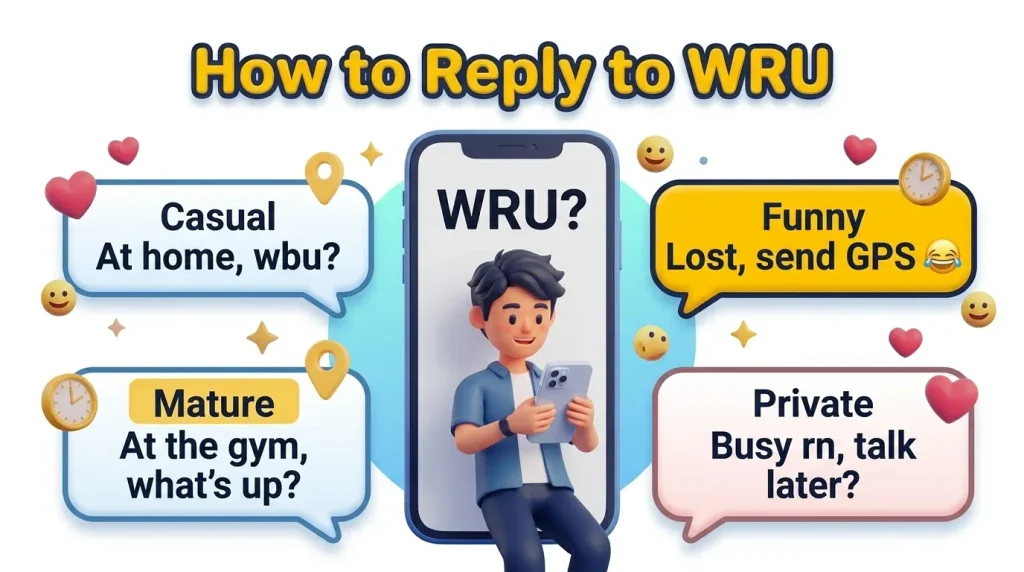
Getting a “wru” text puts a tiny bit of pressure on you to reply, and how you respond can shift the entire tone of the conversation.
The right reply depends on your relationship with the sender, your mood, and the situation. Below are practical reply styles for nearly every scenario you might run into.
| Reply Style | Example Reply | Best Used With |
| Casual | “at home, wbu?” | Friends |
| Funny | “lost in the sauce, send help” | Close friends |
| Mature | “at the gym, all good here” | Partners/coworkers |
| Private | “busy rn, talk later?” | Anyone you’d rather not tell |
Casual Replies
- “just chilling at home rn”
- “on my way, 5 mins”
- “still at work, ugh”
- “out with friends rn”
- “grabbing food, wbu?”
Funny Replies
- “living my best life obviously”
- “in another dimension, send snacks”
- “lost, send GPS”
- “currently avoiding responsibilities”
- “hiding from adulthood, one sec”
Mature or Confident Replies
- “at home relaxing, what’s up?”
- “just finished work, heading out soon”
- “with family right now, all good”
- “running errands, back in an hour”
- “at the gym, texting during rest 😅”
Respectful or Private Replies
- “just busy, I’ll fill you in later”
- “can’t really say right now”
- “somewhere quiet, talk soon”
- “handling something, I’ll update you”
- “prefer not to say over text”
Example in chat: Friend 1: wru Friend 2: at home, why what’s up?
Regional and Cultural Usage of WRU
Texting slang doesn’t look the same everywhere, and wru meaning shifts slightly depending on regional habits and cultural texting norms.
While the core definition stays consistent globally, how often and how casually people use it varies quite a bit from region to region.
- Western culture extremely common in daily casual texting
- Asian culture often mixed with local slang or emojis
- Middle Eastern culture used similarly but sometimes replaced by voice notes
- Global internet culture unifies most regions through shared meme language
- Younger generations worldwide adopt it faster than older ones
Western Culture
In the US, UK, and similar regions, WRU is deeply embedded in everyday casual texting, especially among teens and young adults coordinating plans.
Asian Culture
Across many Asian countries, WRU often blends with local slang or gets replaced by app-specific stickers, though the English abbreviation still appears frequently in bilingual chats.
Middle Eastern Culture
In parts of the Middle East, quick voice notes sometimes replace short texts like WRU, but the abbreviation still shows up heavily in younger, urban texting circles.
Global Internet Culture
Thanks to social media slang spreading through memes, comments, and viral trends, WRU has become almost universally recognized regardless of language barriers.
Example in texting: Friend 1: wru, everyone’s already asking Friend 2: 2 mins away, tell them to chill lol
Pros and Cons of Using WRU in Conversations
Like most texting shortcuts, WRU has clear upsides, but it’s not always the perfect choice depending on who you’re talking to.
Weighing these small trade-offs helps you decide when the wru full form actually fits the conversation versus when a fuller sentence works better.
- Pro: Saves time and feels effortless to type
- Pro: Matches casual, friendly conversational tone
- Con: Can feel cold or abrupt without emojis
- Con: Risky with people who don’t know texting slang
- Pro: Universally recognized across most platforms
Example in chat: Friend 1: my grandma texted me wru and I was so confused she knew that lol Friend 2: slang is spreading generations now 😂
Texting Etiquette: When Is WRU Appropriate?
Knowing when to send a short abbreviation versus a full sentence says a lot about texting etiquette, especially with people outside your close circle.
Generally, save WRU for people you already text casually, and default to full phrasing with new contacts, professional settings, or older relatives unfamiliar with texting slang.
- Use it freely with close friends and long-term contacts
- Avoid it in first-time conversations with strangers
- Skip it entirely in formal or work-related messages
- Add a smiley if the recipient might misread tone
- Match the abbreviation level of the person you’re texting
Example in texting: Friend 1: is it weird to text my boss wru Friend 2: yeah definitely spell it out for that one lol
WRU in Pop Culture and Memes
Short texting terms like WRU rarely stay confined to private chats they often spill into memes, captions, and comment sections everywhere online.
Because it’s short and universally understood, WRU frequently shows up in relatable memes about waiting for a friend, flaky plans, or dramatic group chat moments.
- Common caption format for “waiting on someone” memes
- Used ironically in posts about flaky friends
- Appears in TikTok skits about texting culture
- Referenced in relationship humor about clingy texting
- Recognized meme-format shorthand across platforms
Example in chat: Friend 1: saw a meme that was literally just “wru” repeated 10 times lol Friend 2: accurate representation of our group chat tbh
FAQs
What does WRU stand for in texting?
WRU usually stands for “where are you.” That’s the wru full form most people use when checking someone’s location casually.
Is WRU always about location?
Mostly, yes. Occasionally, especially in gaming chats, the wru meaning shifts to “who are you,” but location remains far more common.
Is WRU rude to send?
No, it’s generally friendly. However, the wru full form can feel cold without emojis or context, so tone matters.
Can WRU be used at work?
It’s best avoided professionally. Spelling out the full phrase keeps wru meaning clear and appropriate for coworkers or clients.
What’s the difference between WRU and WYA?
They’re nearly identical. Both share the same wru meaning, asking about someone’s current location in a casual way.
How do you reply to WRU?
Simply share your location or situation. Matching the sender’s tone keeps the wru full form conversation feeling natural and easy.
Is WRU only used by teens?
Not anymore. While teens popularized it, the wru meaning has spread across nearly every age group through everyday texting habits.
Conclusion
At the end of the day, the wru full form really is as simple as “where are you,” even though it occasionally shifts to “who are you” depending on context. Understanding the wru meaning helps you avoid awkward mix-ups and respond with the right tone every time.
Whether it shows up in a WhatsApp chat, an Instagram DM, or a TikTok comment, the intent behind wru full form usually comes from genuine curiosity or care. Next time it lands in your messages, you’ll know exactly what’s being asked and exactly how to reply without overthinking it.

Grace Anderson is an English language writer who shares clear grammar lessons, practical writing tips, and helpful examples for learners.






1 thought on “WRU Full Form Meaning: The Secret Meaning Revealed! 2026”