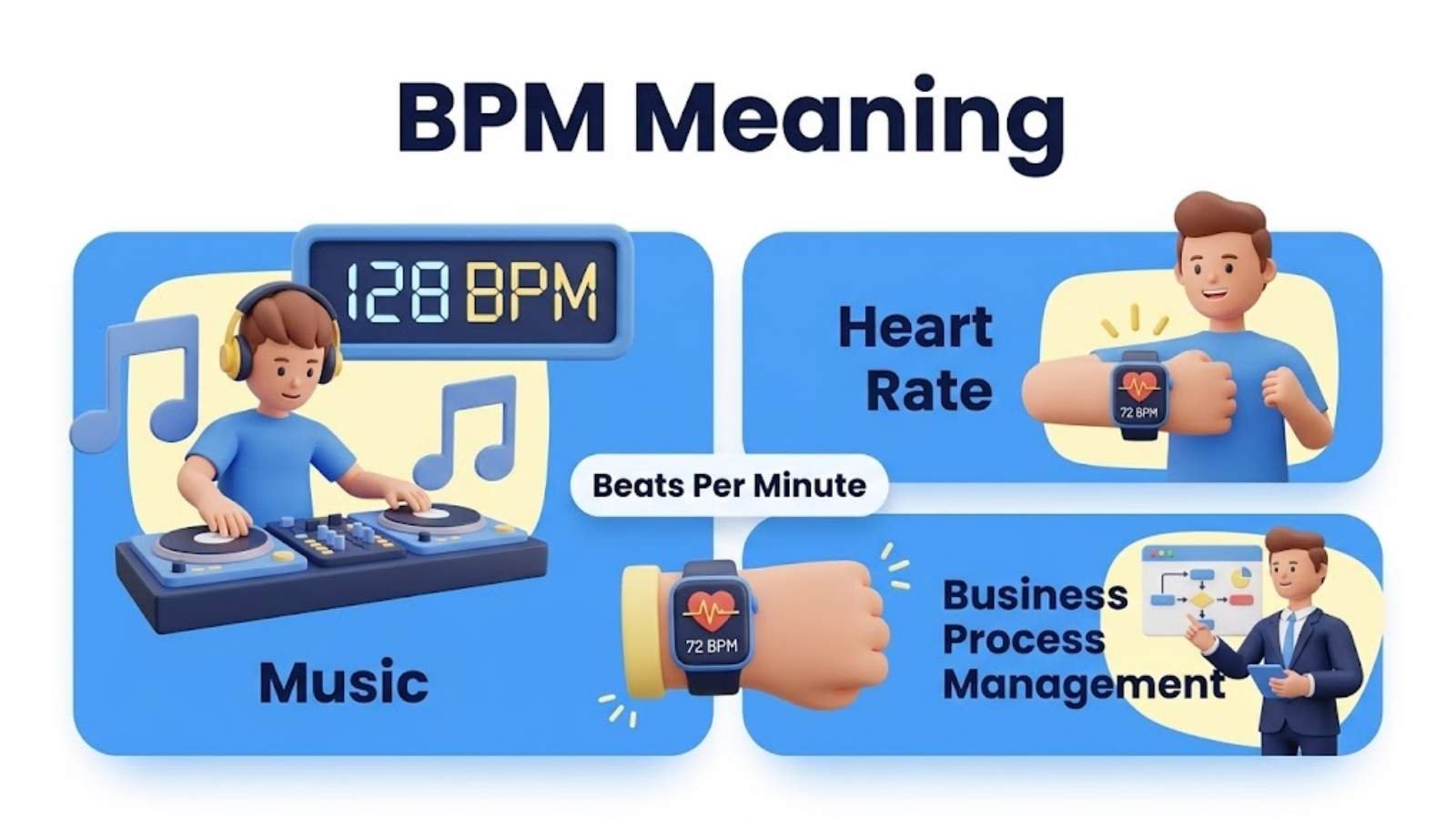
You saw “BPM” pop up in a text, a fitness app, or a song description, and for a second your brain just blanked. It happens to everyone one tiny abbreviation, and suddenly you’re not sure if someone’s talking about their heart, a playlist, or a spreadsheet at work.
That’s exactly why this guide exists. Here you’ll get the full bpm meaning, real examples from chats and DMs, and a clear answer to What Does BPM Mean? in every context it shows up. By the end, you’ll never have to guess again so let’s get into it.
BPM – Quick Meaning
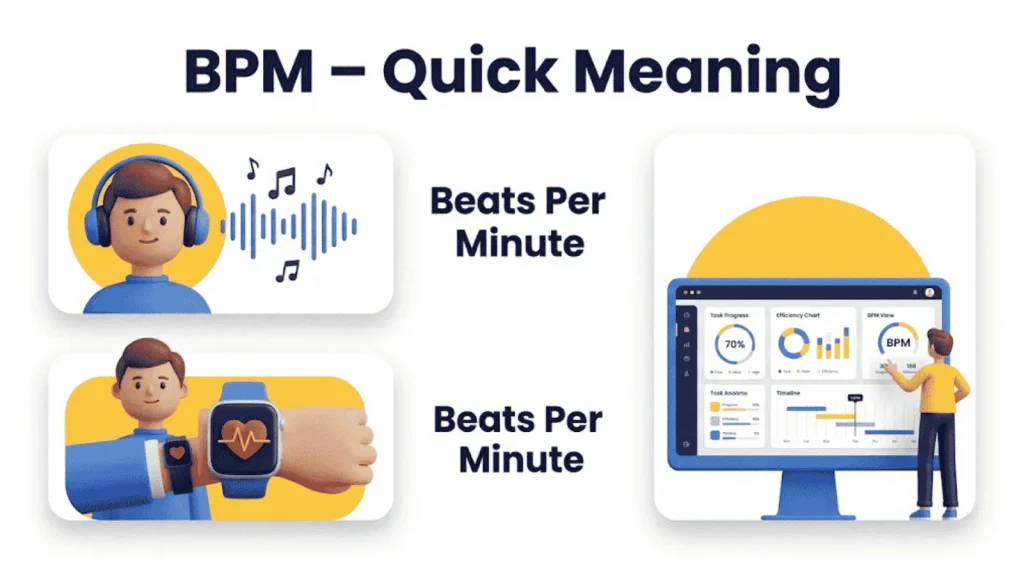
BPM stands for Beats Per Minute, and its bpm meaning shifts depending on where you see it music, health, or business. What Does BPM Mean? In short: it’s a rate, a speed, a pulse of something happening again and again in sixty seconds.
What Does BPM Stand For at a Glance?
- Music: number of beats in one minute of a song.
- Heart rate: number of heartbeats per minute.
- Business: short for Business Process Management.
- Fitness: pace used to track workout intensity.
- Gaming: rhythm-game scoring tied to song tempo.
- DJ culture: the number used to match tracks together.
- Texting: casual shorthand friends use for heart rate or vibe.
Example in texting: Friend 1: “Bro my BPM was crazy during that run 😩” Friend 2: “Lol how high did it get?”
BPM meaning
The bpm meaning always circles back to one idea: counting a repeating pulse. Whether it’s your heart or a bassline, What Does BPM Mean? comes down to rhythm, rate, and pace measured every sixty seconds.
Most Common Definitions
Most people run into BPM in three main worlds music, medical, and business and each one uses the term a little differently.
- Music: tempo of a track, e.g., 128 BPM for house music.
- Medical: your heart rate, checked at rest or during activity.
- Business: Business Process Management, a corporate improvement method.
- Fitness: target zones used in cardio training plans.
- Internet slang: casual shorthand in chats about mood or energy.
Simple Definition
If someone asks you to explain it in one line: BPM is simply how many times something happens in one minute a beat, a heartbeat, or a business cycle.
- Beat: one pulse or hit in music.
- Minute: the fixed time window used to count.
- Rate: the resulting number, like 72 or 140.
- Context: decides whether it’s music, health, or work.
- Universal: used the same way across countries and platforms.
Example Quotes
Real-world phrasing helps the bpm meaning click faster than any dictionary definition could.
- “This track is 130 BPM, perfect for the gym.”
- “My resting BPM dropped after I started running.”
- “Our team adopted BPM software to fix slow workflows.”
- “The DJ matched the BPM for a smooth transition.”
- “Doctor said my BPM was a little high today.”
Example in chat: Friend 1: “What’s this song’s BPM? It feels so fast” Friend 2: “128 BPM, that’s why it hits like that”
Origin & Background
Understanding where BPM came from makes the bpm meaning stick it didn’t start online, it started with sound and the human pulse itself.
What Is the History Behind the Word BPM?
- Metronomes: early inventors used ticking devices to set tempo.
- 19th century: composers began writing BPM-style tempo markings.
- 20th century: doctors adopted BPM for heart rate readings.
- 1980s-90s: DJs and producers made BPM essential for mixing.
- 2000s onward: fitness trackers and apps popularized the term.
- Today: BPM lives in texting, gaming, and business dashboards too.
Musical Roots
Long before playlists, musicians needed a shared way to describe speed and tempo, and BPM became that universal language.
- Metronome marks gave composers a numeric tempo standard.
- Classical scores used terms like allegro before BPM took over.
- Electronic music made BPM a headline number for every track.
- DJs rely on BPM to beatmatch songs live.
- Producers build entire genres around specific BPM ranges.
Medical Adoption
Doctors borrowed the same counting logic to describe something far more personal: your heartbeat.
- Stethoscopes made counting heartbeats per minute possible.
- Resting heart rate became a key vital sign using BPM.
- Cardiologists use BPM to catch irregular rhythms early.
- Wearables now track BPM in real time all day.
- Fitness coaches use BPM zones to guide training intensity.
Digital & Internet Expansion
Once smartphones and social apps exploded, BPM slipped naturally into everyday online language.
- Fitness apps display live BPM during workouts.
- Music apps like Spotify tag every song’s BPM.
- TikTok trends often mention BPM for dance challenges.
- Texting culture shortened it into casual, funny slang.
- Streaming platforms sort playlists by BPM ranges.
Business & Corporate Use
In offices, BPM means something completely different it’s about fixing how work actually gets done.
- Business Process Management improves company workflows.
- Efficiency: BPM software removes repetitive manual steps.
- Automation: many BPM tools connect to AI and data systems.
- Compliance: BPM helps companies follow legal requirements.
- Scalability: growing businesses lean on BPM to stay organized.
| Era | Field | What BPM Meant |
| 1800s | Classical music | Metronome tempo marking |
| 1900s | Medicine | Heart rate measurement |
| 1980s-90s | DJ/Electronic music | Beatmatching tool |
| 2000s | Fitness & tech | Wearable heart-rate tracking |
| 2010s-Now | Internet & business | Slang + Business Process Management |
Real-Life Conversations
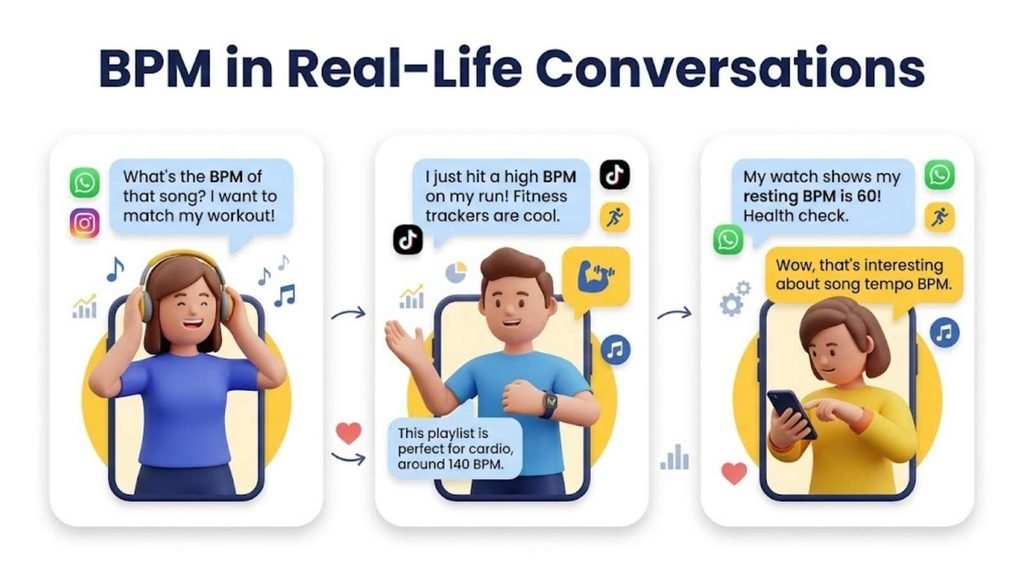
Seeing bpm meaning used naturally in chats makes it click faster than any textbook explanation ever could.
How Do People Actually Use BPM in Chats?
- Fitness talk: friends compare BPM after workouts or runs.
- Music sharing: people tag BPM when sending song links.
- Health check-ins: BPM mentioned after a doctor’s visit.
- Playful teasing: “my BPM spiked” used jokingly about crushes.
- Gaming chats: BPM referenced in rhythm-game score talk.
WhatsApp Chat
WhatsApp threads often bring up BPM casually, especially between friends who track fitness together.
- Screenshots: friends share heart-rate screenshots mid-run.
- Voice notes: some explain their BPM instead of typing.
- Group chats: workout squads compare daily BPM numbers.
- Emojis: 😅 and 🏃 often follow a BPM mention.
- Check-ins: “how’s your BPM today?” as a caring question.
Example in texting: Friend 1: “My BPM hit 170 on that last sprint” Friend 2: “That’s wild, mine barely hits 150”
Instagram DM
On Instagram, BPM often shows up around fitness reels, music posts, or workout story replies.
- Story replies: “what’s the BPM of this song?” is common.
- Fitness influencers: post BPM stats from their sessions.
- DJ pages: tag BPM directly in captions and DMs.
- Playlist requests: fans DM asking for high-BPM tracks.
- Casual banter: “you got my BPM up” used flirtatiously.
Example in chat: Friend 1: “This song slaps, what BPM is it?” Friend 2: “132! Perfect for cardio day”
TikTok Comments
TikTok comment sections turn BPM into shorthand for energy, hype, or a song’s danceability.
- Dance trends: commenters ask for the exact BPM used.
- Workout videos: viewers request the creator’s BPM routine.
- Music discovery: “BPM?” is a common one-word comment.
- Reaction culture: “my BPM after that jumpscare 💀” jokes.
- Remix talk: fans debate which BPM version hits harder.
Text Messages
In plain texting, BPM usually appears in short, quick, no-fuss messages between close friends.
- Quick updates: “BPM’s back to normal now, all good.”
- Workout buddies: comparing numbers right after the gym.
- Playlist swaps: sending a track with its BPM attached.
- Health worries: “BPM felt high earlier, kinda scared me.”
- Humor: exaggerating BPM for comedic effect in group chats.
Emotional & Psychological Meaning
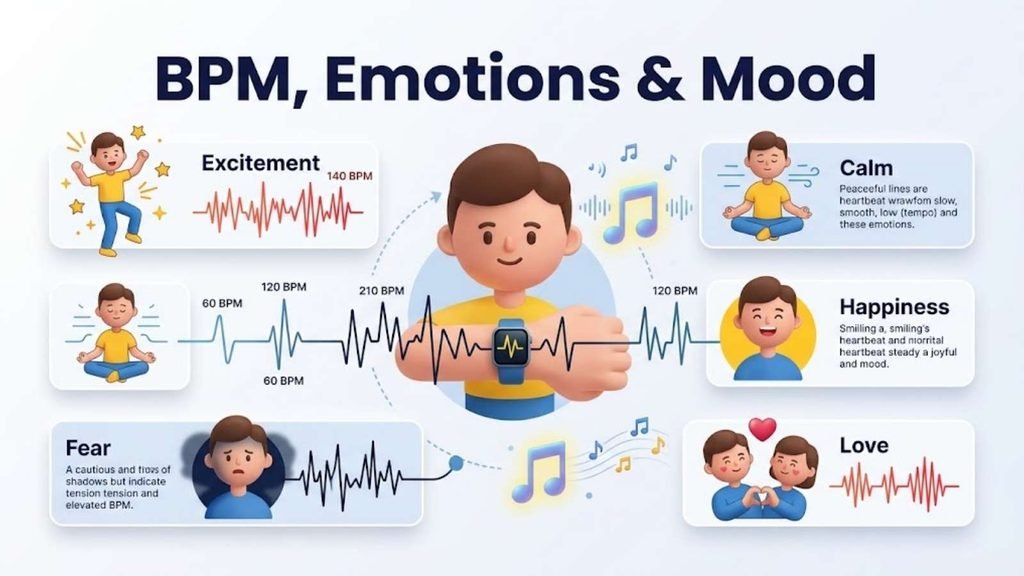
Beyond numbers, the bpm meaning touches something deeper rhythm connects directly to how we feel in any given moment.
Why Does BPM Affect Our Mood So Strongly?
- Fast tempo: raises energy, excitement, and urgency.
- Slow tempo: creates calm, focus, or sadness.
- Heart rate spikes: mirror real emotional reactions like fear or love.
- Workout playlists: use BPM to boost motivation on purpose.
- Meditation apps: use low BPM sounds to slow your pulse.
Music & Mood Connection
Producers don’t pick tempo randomly BPM is chosen specifically to shape how a listener feels.
- EDM tracks: often sit around 128 BPM for peak energy.
- Ballads: usually drop below 80 BPM for emotional weight.
- Workout mixes: favor 140+ BPM to match cardio pace.
- Lo-fi beats: stay slow and steady for relaxed focus.
- Film scores: shift BPM to build tension or release it.
Heartbeat & Emotion
Your heart rate and your emotions are tightly linked, which is why BPM feels personal, not just clinical.
- Nervousness: often raises your BPM before you even notice.
- Excitement: a first date or big moment spikes BPM naturally.
- Fear: sudden scares cause a quick BPM jump.
- Calm: deep breathing lowers BPM within minutes.
- Love: people jokingly blame a crush for a racing BPM.
Psychological Identity
For some people, tracking BPM becomes part of how they understand their own body and habits.
- Self-awareness: knowing your resting BPM builds body trust.
- Anxiety tracking: some monitor BPM during stressful moments.
- Athletic identity: runners often tie BPM to personal goals.
- Music identity: fans identify with specific BPM-driven genres.
- Control: lowering BPM through breathing feels empowering.
Usage in Different Contexts
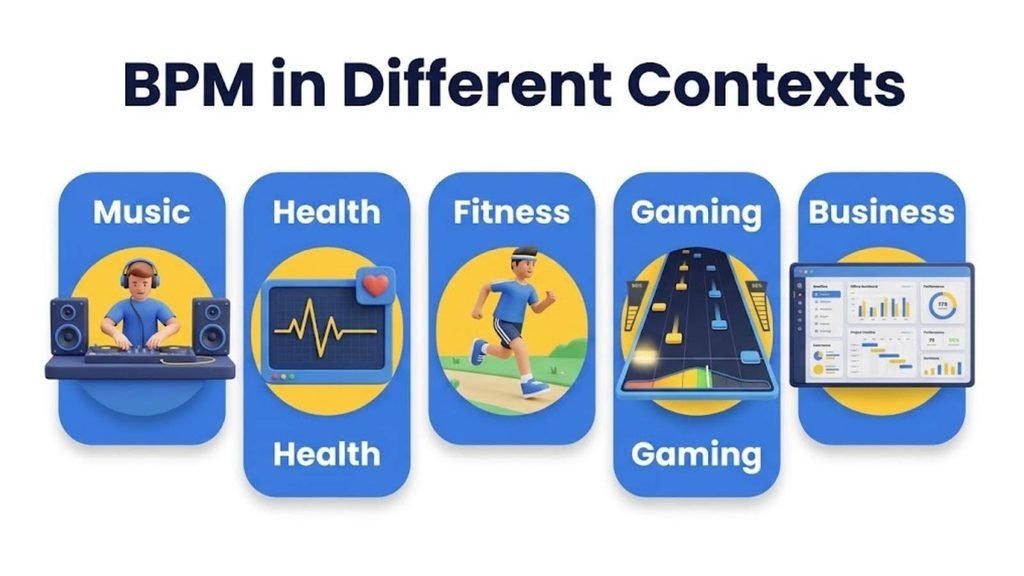
The same three letters can mean very different things depending on where the conversation is happening.
How Does the Meaning of BPM Shift by Situation?
- Social settings: usually about music or playful heart-rate talk.
- Professional settings: almost always Business Process Management.
- Health settings: strictly about actual heartbeat measurement.
- Gaming settings: tied to rhythm-game difficulty and scoring.
- Fitness settings: used to set training zones and goals.
Social Media
Online, BPM is casual, fast, and usually tied to music, fitness, or light humor.
- Captions: creators tag song BPM for dance content.
- Comments: fans ask “what’s the BPM?” under viral clips.
- Stories: fitness influencers share live BPM screenshots.
- Trends: challenges built entirely around a specific BPM.
- Memes: exaggerated BPM jokes about crushes or scares.
Friends & Relationships
Between friends, BPM often becomes shorthand for excitement, nerves, or shared workout goals.
- Teasing: “you raised my BPM” used playfully with crushes.
- Support: checking on a friend’s BPM after a scary moment.
- Fitness bonding: comparing BPM after a shared workout.
- Music sharing: recommending songs based on preferred BPM.
- Inside jokes: BPM used humorously in ongoing group chats.
Work & Professional Settings
In offices, BPM drops the music entirely and becomes a serious operational term.
- Meetings: teams discuss BPM software adoption plans.
- Workflows: BPM maps out each step of a process.
- Automation: BPM tools reduce manual, repetitive tasks.
- Reports: BPM metrics track efficiency improvements.
- Compliance: BPM ensures processes meet legal standards.
Casual vs Serious Tone
Context and tone completely change how BPM should be read.
- Casual tone: playful, quick, often paired with emojis.
- Serious tone: clinical, precise, used in medical settings.
- Professional tone: formal, tied to business strategy.
- Gaming tone: competitive, tied to scoring and skill.
- Fitness tone: motivational, tied to personal targets.
What Does BPM Really Mean in Everyday Life?
For most people, the bpm meaning boils down to two things they actually feel: their own heartbeat and the music playing around them.
- Morning workouts often start conversations about BPM.
- Commute playlists are chosen based on preferred BPM.
- Health apps quietly track BPM in the background daily.
- Casual texts use BPM to describe excitement or nerves.
- Everyday habits connect BPM to both body and mood.
Example in texting: Friend 1: “Woke up and my BPM was still high from that dream 😭” Friend 2: “Dreams shouldn’t be that intense lol”
Common Misunderstandings
Not everyone uses BPM correctly, and a few mix-ups happen again and again in casual conversation.
Which BPM Mistakes Do People Make Most Often?
- Assuming BPM only relates to music or songs.
- Believing high BPM always signals a health problem.
- Thinking every genre needs a fast, high BPM.
- Mixing up heart-rate BPM with business BPM.
- Ignoring the calmer, slower meanings of BPM.
Thinking BPM Only Means Music
Many people assume BPM belongs to musicians and DJs only, missing its bigger picture.
- Reality check: BPM also measures your actual heartbeat.
- Workplaces: use BPM for Business Process Management daily.
- Fitness world: relies on BPM more than music charts do.
- Medical field: uses BPM as a core vital sign.
- Gaming: ties BPM directly to rhythm-based scoring.
Confusing High BPM as Always Bad
A racing BPM isn’t automatically a bad sign context always matters here.
- Exercise: naturally raises BPM as a healthy response.
- Excitement: spikes BPM without any danger involved.
- Fitness goals: often require a temporarily higher BPM.
- Warning signs: only matter if BPM stays high at rest.
- Doctors: look at patterns, not one single BPM reading.
Assuming All Songs Need High BPM
Slower tracks aren’t lesser low BPM songs serve a completely different emotional purpose.
- Ballads: rely on low BPM for emotional depth.
- Lo-fi genres: intentionally stay slow and steady.
- Film scores: use varying BPM to build tension.
- Meditation music: keeps BPM extremely low on purpose.
- Genre identity: BPM range often defines a music style.
Using BPM in Wrong Context
Dropping the wrong “BPM meaning” into a conversation can cause instant confusion.
- Workplace chat: bringing up heart rate instead of processes.
- Doctor visits: mentioning music tempo instead of health.
- DJ sets: confusing business BPM with track tempo.
- Casual texts: overexplaining technical BPM definitions.
- Clarify first: always check which BPM someone means.
Comparison Table
Sometimes a side-by-side view explains the bpm meaning faster than paragraphs ever could.
| Field | What BPM Stands For | Typical Range | Where You’ll See It |
| Music | Beats Per Minute | 60-180+ | Playlists, DJ sets, apps |
| Health | Heart rate | 60-100 (resting) | Fitness trackers, hospitals |
| Business | Business Process Management | N/A (methodology) | Corporate software, meetings |
| Fitness | Training heart rate | 120-170 (active) | Gym classes, running apps |
| Gaming | Song rhythm speed | 90-160 | Rhythm and dance games |
Why Does BPM Matter So Much in Health and Music?
Whether it’s your pulse or a playlist, BPM quietly controls how your body and mind respond in real time.
- Health: abnormal BPM can flag early warning signs.
- Fitness: correct BPM zones make workouts more effective.
- Music: BPM shapes energy, genre, and emotional tone.
- Sleep: resting BPM reflects overall recovery quality.
- Performance: athletes train specific BPM zones for results.
Variations / Types of BPM
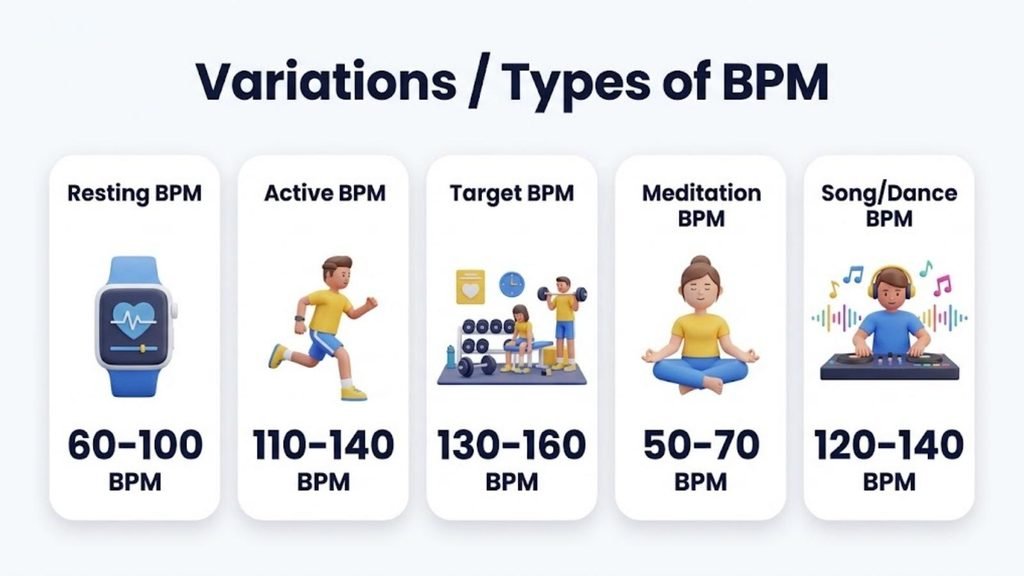
BPM isn’t just one number it changes depending on activity, goal, and context throughout your day.
What Are the Different Types of BPM People Track?
- Resting: your baseline heart rate while relaxed.
- Active: heart rate during movement or light activity.
- Target: the ideal zone for effective training.
- Song: tempo assigned to a specific music track.
- Business: process-management speed and efficiency metrics.
Resting BPM
Your resting BPM reflects overall heart health and fitness level better than almost any other single number.
- Average adults: typically sit between 60-100 BPM.
- Athletes: often show a lower resting BPM.
- Sleep quality: directly affects your resting BPM.
- Stress levels: can raise resting BPM over time.
- Tracking: best measured first thing in the morning.
Active BPM
Active BPM rises the moment you start moving, climbing stairs, or picking up the pace.
- Walking: mild increase above resting BPM.
- Jogging: moderate, steady BPM elevation.
- Sprinting: sharp, fast BPM spike.
- Recovery: how quickly BPM drops after activity matters most.
- Monitoring: wearables track active BPM continuously.
Target BPM
Target BPM is the zone trainers use to make workouts actually effective.
- Fat-burning zone: roughly 60-70% of max BPM.
- Cardio zone: around 70-85% of max BPM.
- Peak zone: 85%+ of max BPM, short bursts only.
- Formula: 220 minus age gives an estimated max BPM.
- Personalization: fitness level changes ideal target BPM.
Song BPM
Song BPM defines the tempo and energy of a music track before a single lyric even plays.
- Hip-hop: often sits around 85-115 BPM.
- Pop: usually falls between 100-130 BPM.
- House/EDM: commonly ranges from 120-130 BPM.
- Drum and bass: pushes toward 160-180 BPM.
- Ballads: typically stay under 80 BPM.
Dance BPM
Dance BPM is tuned specifically to keep bodies moving and energy high on the floor.
- Club tracks: usually land between 118-128 BPM.
- Latin dance: varies widely by specific style.
- Techno: often pushes past 130 BPM.
- Choreography: dancers count beats to match steps.
- Energy control: DJs raise BPM to build peak moments.
DJ Transition BPM
DJs rely on precise BPM matching to blend songs without breaking the crowd’s momentum.
- Beatmatching: aligning BPM of two tracks manually.
- Software help: modern tools auto-detect BPM instantly.
- Gradual shifts: smooth sets slowly change BPM over time.
- Genre blending: similar BPM makes genre mixing easier.
- Crowd energy: BPM shifts control dancefloor momentum.
Meditation BPM
Meditation intentionally targets a slower BPM to guide the body into a calmer state.
- Breathing exercises: naturally lower heart-rate BPM.
- Ambient music: composed with very low BPM.
- Guided sessions: often mention slowing your BPM.
- Stress relief: lower BPM signals reduced anxiety.
- Consistency: regular practice steadily lowers baseline BPM.
Running BPM
Runners watch BPM closely to avoid overtraining and to track real progress.
- Easy runs: moderate, sustainable BPM zone.
- Tempo runs: pushes BPM higher for set periods.
- Interval training: alternates BPM between high and low.
- Playlists: matched to running cadence and BPM.
- Recovery runs: kept deliberately low in BPM.
Business BPM
In corporate settings, Business BPM focuses on speed and consistency of workflows, not heartbeats.
- Process mapping: visualizes each workflow step clearly.
- Automation tools: speed up repetitive business tasks.
- KPIs: measure how efficient a process actually is.
- Continuous improvement: BPM is never a one-time fix.
- Software platforms: manage BPM across entire departments.
Gaming BPM
Rhythm games are built entirely around matching a track’s BPM to player timing.
- Note charts: synced precisely to song BPM.
- Difficulty levels: often scale with higher BPM.
- Scoring systems: reward accuracy against the beat.
- Popular titles: many rhythm games display BPM on-screen.
- Player skill: improves with practice at higher BPM.
| BPM Type | Typical Range | Best Used For |
| Resting | 60-100 | Daily health tracking |
| Active | 100-160 | Exercise, movement |
| Target (cardio) | 120-170 | Structured workouts |
| Meditation | Well below resting | Relaxation, stress relief |
| Song/Dance | 90-180 | Music, choreography |
How to Calculate Your BPM Accurately
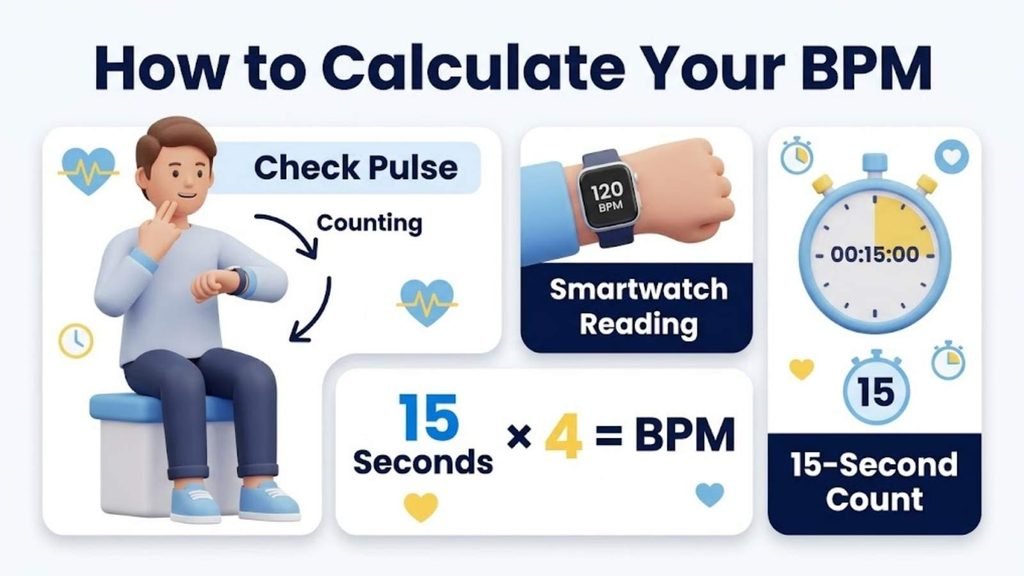
Knowing your real BPM takes less effort than most people think, and the method barely changes across situations.
- Pulse check: count beats for 15 seconds, multiply by four.
- Wearables: smartwatches calculate BPM automatically and continuously.
- Music software: analyzes waveforms to detect exact song BPM.
- Manual tapping: tap along to a beat, use a BPM counter.
- Consistency matters: measure at the same time daily for accuracy.
Example in chat: Friend 1: “How do I even check my BPM without a watch?” Friend 2: “Count your pulse 15 seconds, times four, easy”
Best Apps and Tools to Track BPM
The right app turns confusing numbers into something you can actually understand and use.
- Fitness trackers: Apple Watch, Fitbit, and Garmin monitor BPM.
- Music apps: Spotify and Tunebat display exact song BPM.
- DJ software: Serato and Rekordbox auto-detect track BPM.
- Medical devices: pulse oximeters give quick, accurate BPM readings.
- Meditation apps: Calm and Headspace track BPM during sessions.
| Tool Type | Example Apps | Main Use |
| Fitness tracker | Fitbit, Apple Watch | Real-time heart-rate BPM |
| Music BPM finder | Tunebat, GetSongBPM | Song tempo lookup |
| DJ software | Rekordbox, Serato | Beatmatching, mixing |
| Business BPM tool | Bizagi, Camunda | Workflow management |
When Should You Use BPM in a Conversation?
Timing matters dropping “BPM” at the wrong moment can confuse the entire conversation instantly.
- Fitness chats: perfect moment to mention BPM naturally.
- Music discussions: BPM adds useful, specific detail.
- Health updates: BPM explains exactly how your body reacted.
- Work meetings: BPM signals process improvement, not heart rate.
- Casual banter: BPM works well for light, playful teasing.
How to Respond When Someone Uses “BPM”
Once you understand the bpm meaning in context, replying naturally becomes second nature almost instantly.
What’s the Best Way to Reply When Someone Mentions BPM?
- Ask context: “Music or heart rate BPM?” clears confusion fast.
- Match energy: casual BPM comments deserve casual replies.
- Share your own: comparing numbers keeps the chat engaging.
- Add humor: playful BPM jokes lighten fitness or crush talk.
- Stay respectful: health-related BPM deserves a caring tone.
Casual Replies
- “Lol same, my BPM was through the roof too.”
- “That’s a solid BPM for a warm-up honestly.”
- “No wonder, that song’s BPM is insane.”
- “Mine usually sits way lower than that BPM.”
- “BPM gang, we out here suffering together 😂”
Funny Replies
- “My BPM just from reading this message, ngl.”
- “That’s not a heartbeat, that’s a drum solo.”
- “Bro your BPM sounds like a Red Bull commercial.”
- “At that BPM you basically ran a marathon.”
- “My BPM spikes just thinking about Mondays.”
Mature / Confident Replies
- “Good to know your BPM how’d the session feel?”
- “That’s a healthy range, keep tracking it consistently.”
- “Appreciate you sharing, BPM data really helps planning.”
- “Solid progress, your BPM control has clearly improved.”
- “Let’s use that BPM info to adjust your training.”
Private / Respectful Replies
- “Thanks for telling me, hope your BPM settles down.”
- “Let me know if that BPM feels off again.”
- “I’m here if you want to talk about it more.”
- “Sending that to a doctor sounds like a good idea.”
- “Take it easy, your body’s telling you something.”
Regional & Cultural Usage
BPM travels well across languages and cultures, though the emphasis shifts depending on where you are.
Does BPM Mean the Same Thing Around the World?
- Universally understood: BPM rarely needs translation globally.
- Music-heavy regions: lean more into tempo-based meanings.
- Corporate hubs: emphasize Business Process Management instead.
- Fitness culture: growing everywhere, boosting health-based BPM use.
- Internet slang: spreads BPM’s casual meaning worldwide fast.
Western Culture
In the West, BPM is closely tied to fitness culture, gym playlists, and mainstream dance music.
- Gym culture: heavily influences everyday BPM conversations.
- EDM festivals: keep music BPM part of pop culture.
- Corporate America: widely adopts BPM software solutions.
- Wearable tech: mainstream adoption normalized BPM tracking.
- Social media: casual BPM slang spreads quickly here.
Asian Culture
Across Asia, BPM shows up strongly in K-pop production and rapidly growing fitness tech markets.
- K-pop industry: carefully engineers BPM for hit choreography.
- Fitness apps: booming market across major Asian cities.
- Business sector: BPM adoption growing in large corporations.
- Gaming culture: rhythm games remain hugely popular here.
- Health awareness: rising interest in personal BPM tracking.
Middle Eastern Culture
In the Middle East, BPM blends traditional music rhythms with modern fitness and business trends.
- Traditional music: complex rhythms predate modern BPM counting.
- Fitness growth: gyms increasingly promote BPM tracking.
- Business modernization: companies adopting BPM software steadily.
- Youth culture: embracing global music BPM trends online.
- Healthcare: standard BPM monitoring used in hospitals.
Global Internet Usage
Online, BPM has become a shared shorthand that barely needs explaining anymore.
- Meme culture: BPM jokes translate across language barriers.
- Cross-platform: same slang appears on Instagram, TikTok, X.
- Fitness communities: global groups compare BPM achievements.
- Music forums: BPM discussed the same way worldwide.
- Universal shorthand: three letters, understood almost everywhere.
BPM Meaning in Music Genres Explained
Every genre has a natural home base for BPM, and knowing these ranges helps explain why songs feel the way they do.
| Genre | Typical BPM Range | Feel |
| Ballads/R&B | 60-80 | Emotional, slow |
| Hip-Hop | 85-115 | Groove-heavy |
| Pop | 100-130 | Upbeat, catchy |
| House/EDM | 120-130 | Energetic, danceable |
| Drum & Bass | 160-180 | Fast, intense |
- Slow genres: prioritize emotion over energy.
- Mid-tempo genres: balance groove with accessibility.
- Fast genres: built for movement and adrenaline.
- Producers: choose BPM before writing a single note.
- Listeners: often pick playlists by BPM without realizing it.
FAQs
What Does BPM Mean in Texting?
In texting, BPM usually refers to heart rate or a song’s tempo, depending on the conversation’s context.
Is a High BPM Always Dangerous?
No, a high BPM is often normal during exercise, excitement, or stress, not automatically dangerous.
What Is a Normal Resting BPM?
A normal resting bpm meaning for most healthy adults falls between 60 and 100 beats per minute.
What Does BPM Stand For in Business?
In business, BPM stands for Business Process Management, a method for improving company workflows.
How Do DJs Use BPM?
DJs use BPM to match tempo between songs, creating smooth transitions during live sets.
Can BPM Affect My Mood?
Yes, music BPM directly influences energy and emotion, from calm ballads to high-energy dance tracks.
Why Do Fitness Apps Track BPM?
Fitness apps track BPM to measure workout intensity and help users train within safe, effective zones.
Conclusion
At the end of the day, the bpm meaning isn’t complicated once you know the context; it’s simply a rate, whether that’s your heartbeat, a song’s tempo, or a business workflow. Understanding bpm meaning helps you read texts, DMs, and playlists without any confusion. Next time someone asks What Does BPM Mean?, you’ll already know whether they mean music, health, or work.
Keep this guide handy, because bpm meaning shows up more often than you’d expect in gym chats, DJ sets, and even office meetings. The next time those three letters appear, pause for a second, check the context, and respond with confidence instead of confusion.

Grace Anderson is an English language writer who shares clear grammar lessons, practical writing tips, and helpful examples for learners.








2 thoughts on “BPM Meaning: The Real Truth You Need to Know (2026)”