You get a text, you reply honestly, and the other person just sends back “ohrd.” No punctuation, no emoji, nothing. Your brain immediately starts spiraling, are they mad? Bored? Judging you silently from across the group chat?
That little four-letter reply carries more weight than it should, and this guide is here to clear that up. We’ll break down the ohrd meaning in text, where it came from, how people actually use it in real conversations, and exactly what does ohrd mean in text depending on who’s sending it. By the end, you’ll never have to guess again and keep reading.
OHRD Meaning in Text – Quick Meaning
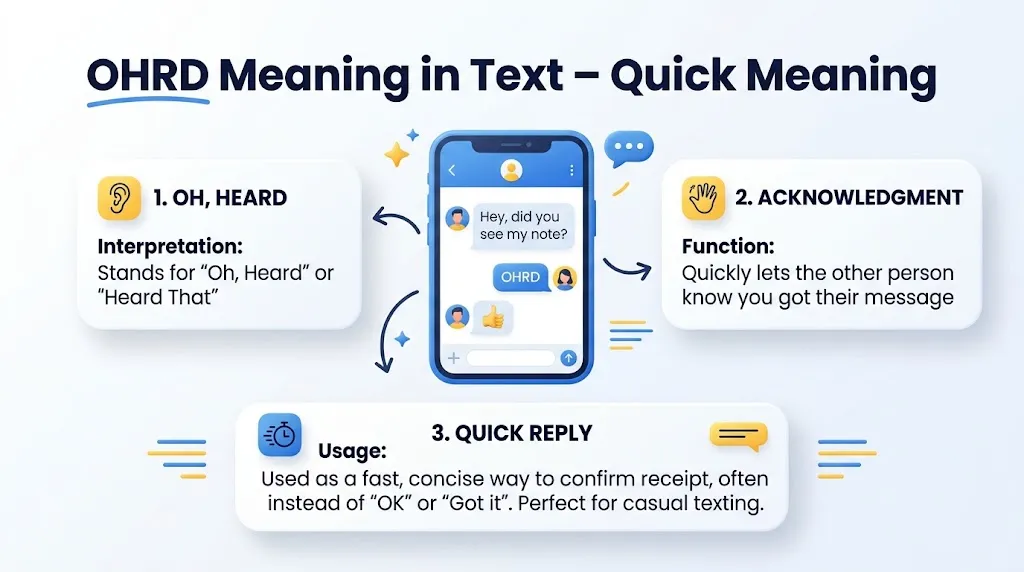
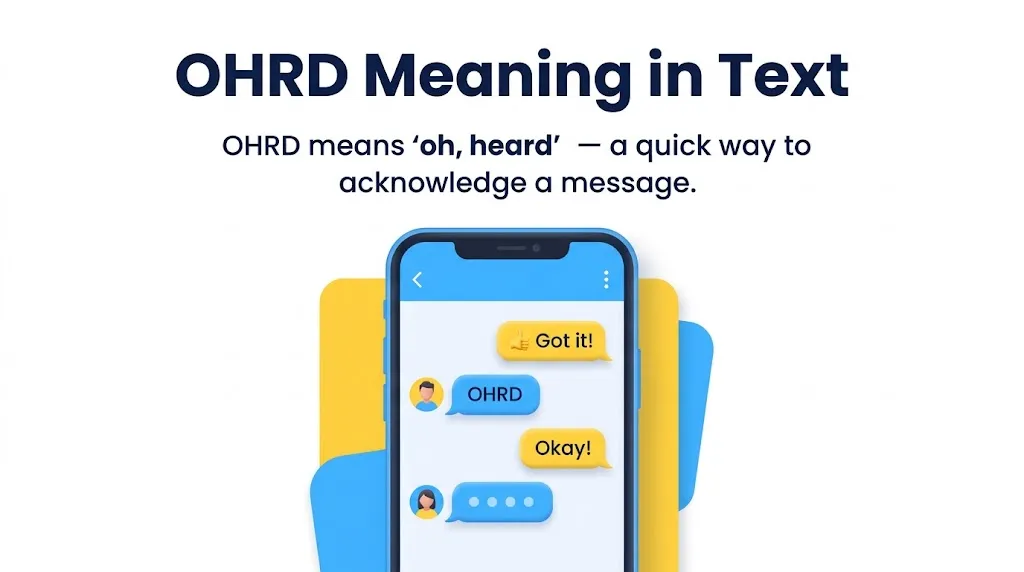
Before anything else, here’s the short version. Ohrd is an internet shorthand for “oh, heard” a quick, low-effort way of saying you received and understood a message. It’s casual, it’s fast, and it’s everywhere in texting slang and DM culture right now.
Simple Breakdown:
- O-H-R-D breaks down as a clipped, vowel-dropped version of “oh heard”
- It works like a digital nod acknowledgment without extra words
- No universal punctuation rule people type it lowercase, capitalized, or with extra letters
- Tone depends entirely on context and what came before it
- It belongs to a bigger family of internet slang built on dropped vowels (like “hbu,” “wyd,” “sm”)
Example Usage:
Example in texting: Friend 1: bro said he’s not coming to the party tonight Friend 2: ohrd, that’s wild
What does Ohrd mean in text
Ohrd is a shorthand acknowledgment, and understanding what does ohrd mean in text really comes down to reading the room. On the surface, it just means “I heard/understood that.” But like most text abbreviations, its emotional weight shifts with tone, punctuation, and timing.
How Is OHRD Used in Everyday Conversations?
- Used to confirm receipt of information without over-explaining
- Can signal mild disinterest when sent with no follow-up
- Often paired with emojis to soften or sharpen the tone
- Common in fast-paced chats where typing full sentences feels unnecessary
- Popular among Gen Z texting slang users who favor minimal replies
| Context | Likely Meaning of OHRD |
| After casual gossip | Simple acknowledgment, no big reaction needed |
| After bad news | Processing, might need a follow-up question |
| Ending a conversation | Polite way to close things out |
| No emoji, flat tone | Could read as disinterest or annoyance |
| With 😂 or 👀 | Playful, engaged, inviting more chat |
Example in chat: Friend 1: I think I failed that test not gonna lie Friend 2: ohrd 😭 we’ll figure it out
Origin & Background
Slang like this doesn’t appear overnight; it evolves out of texting culture, internet slang, and the constant push to type faster. The origin of ohrd follows a pattern familiar to anyone who’s grown up chatting online.
Where Did OHRD Slang Actually Come From?
- Rooted in the broader trend of vowel-dropping in digital communication
- Grew alongside similar terms like “ngl,” “fr,” and “istg”
- Popularized through texting apps and messaging platforms, not formal writing
- Spread quickly through screenshots and shared conversations online
- Became normalized as casual chat replaced longer, formal texting
How It Started:
- Likely evolved from typing “oh heard” quickly and dropping vowels for speed
- Fits the pattern of other clipped acknowledgments in texting slang
- Gained traction in group chats before spreading to DMs and comments
- No single “inventor” it grew organically through repeated use
- Became embedded in everyday online communication over time
Internet Influence:
- TikTok comment sections helped normalize ultra-short replies like this one
- Instagram DMs and Snapchat chats favor speed over grammar
- Meme culture rewards short, punchy, recognizable phrases
- Younger users adopted it as part of their default texting vocabulary
- Cross-platform use cemented it as genuine internet slang, not a typo
Real-Life Conversations (How People Actually Use It)
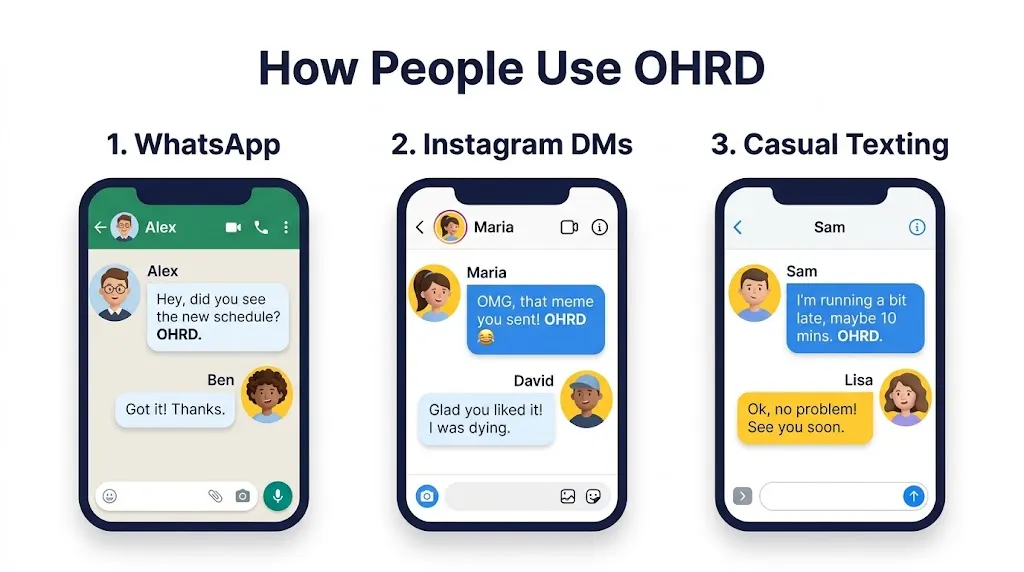
Reading definitions only gets you so far seeing ohrd in actual real-life conversations is what makes the meaning click. Here’s how it shows up across different messaging platforms and situations.
Where Do You See OHRD Most Often?
- Shows up constantly in group chats as a quick response
- Common in Instagram DMs when someone shares news or updates
- Appears in WhatsApp chats between close friends
- Used in comment replies under posts or stories
- Shows up in casual texting between coworkers who are also friends
1. WhatsApp Chat
Example in texting: Friend 1: leaving in 10, traffic looks bad Friend 2: ohrd, drive safe
2. Instagram DMs
Example in chat: Friend 1: just posted the pics from last night Friend 2: ohrd omg send me the good ones
3. Casual Text Message
Example in texting: Friend 1: change of plans, dinner’s at 8 now Friend 2: ohrd noted
Emotional & Psychological Meaning
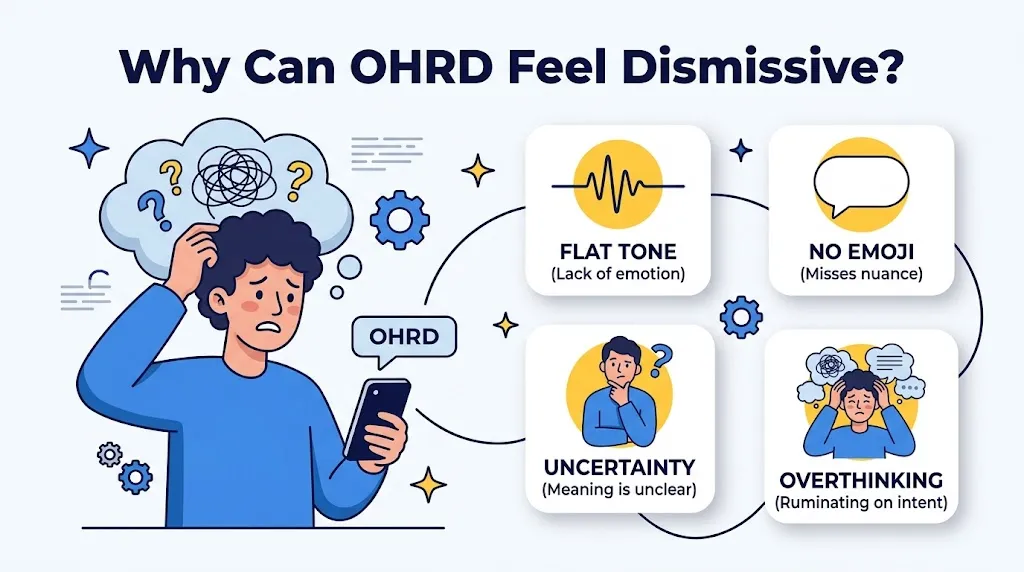
There’s more going on behind a simple ohrd than people realize. The emotional meaning behind short texting slang often reflects how comfortable or how rushed someone feels in the conversation.
Why Does OHRD Feel Dismissive Sometimes?
- Short replies can feel emotionally flat even when no harm is meant
- Lack of punctuation or emojis strips out tone entirely
- Readers often fill emotional gaps with their own assumptions
- Fast typing habits don’t always match how someone actually feels
- Context from earlier messages matters more than the word itself
It reflects:
- Comfort level between the people texting
- How much effort someone is willing to put into a reply
- The general pace of the conversation up to that point
- Whether the sender is distracted or fully present
- Personality style some people just text minimally by nature
Why people use it:
- It’s fast and requires almost no typing effort
- Feels more casual than a full sentence reply
- Works as a safe, neutral response when unsure what to say
- Keeps the conversation moving without overexplaining
- Matches the tone of quick, back-and-forth digital chatting
Usage in Different Contexts
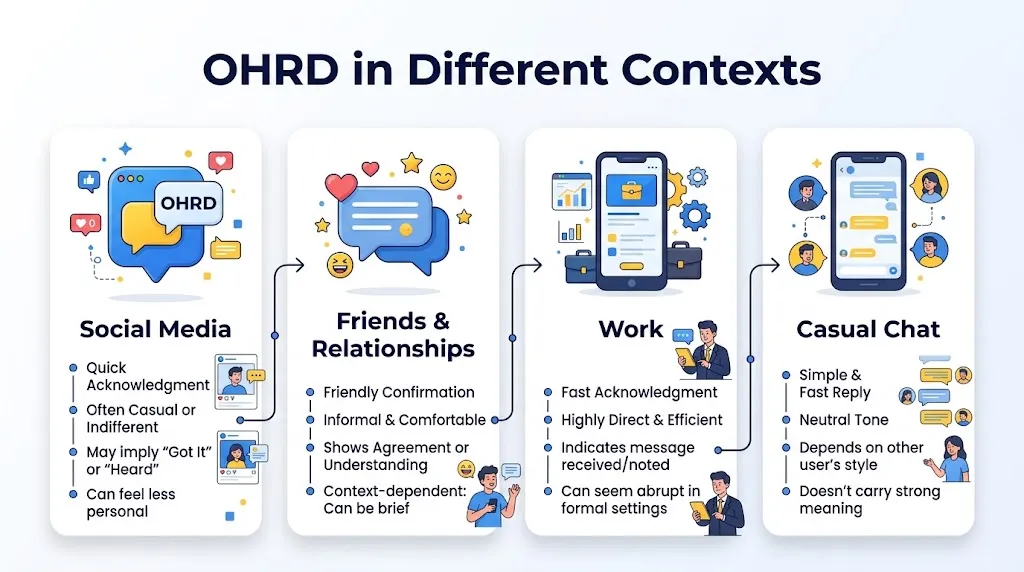
Ohrd doesn’t mean the same thing everywhere. Usage shifts heavily depending on who’s texting, the platform, and the overall vibe of the relationship.
Does OHRD Mean Something Different at Work vs. With Friends?
- Friends treat it as normal, low-stakes shorthand
- Coworkers may read it as unprofessional in formal threads
- Meaning shifts based on relationship closeness
- Tone markers like emojis change how it lands
- Platform matters Slack reads differently than a group chat
1. Social Media
- Common in comment sections and reply threads
- Signals quick engagement without writing a full response
- Often paired with reaction emojis for extra tone
- Works well in casual public-facing interactions
- Rarely used on professional social platforms like LinkedIn
2. Friends & Relationships
| Situation | How OHRD Typically Lands |
| Close friends, daily texting | Totally normal, no confusion |
| New friend or acquaintance | Can feel slightly cold or unclear |
| Partner sharing something personal | May feel dismissive without a follow-up |
| Group chat banter | Playful, low-stakes, easily understood |
3. Work or Professional Settings
- Best avoided in formal emails or official documentation
- Acceptable in casual internal chats with close coworkers
- Can create miscommunication with clients or managers
- Safer to spell things out fully in professional settings
- Save the slang for after-hours or personal messaging
4. Casual vs Serious Tone
- Casual tone: quick updates, plans, light gossip
- Serious tone: bad news, apologies, emotional conversations
- Using ohrd in serious moments can read as careless
- Adding a follow-up question softens a serious response
- Reading the emotional weight of the topic matters most
What Does OHRD Really Mean in Texting?
This is the question most people are actually typing into Google, and the honest answer is simple: it almost always means “oh, heard” a quick nod that a message landed and was understood.
- At its core, it’s just acknowledgment, nothing more sinister
- The real meaning depends on tone, not the word itself
- It rarely carries hidden meaning unless the context suggests otherwise
- Most senders aren’t overthinking it you shouldn’t either
- Texting slang like this is meant to save time, not create drama
Common Misunderstandings
Because ohrd is so short, it’s easy to misread. Common misunderstandings pop up when readers assume tone that was never intended by the sender.
Why Do People Misread OHRD So Often?
- Text lacks tone of voice, so readers guess emotional intent
- A flat reply can feel cold even when it isn’t meant that way
- Overthinking short replies is extremely common in digital communication
- Past experiences with someone shape how their texts get interpreted
- Anxiety around texting often amplifies perceived negativity
Common Confusions:
- Mistaking it for disinterest when it’s actually just brevity
- Confusing it with other similar-looking abbreviations
- Assuming it always needs a longer reply back
- Reading sarcasm into it when none was intended
- Thinking it’s a new term when it’s been around a while
When Meaning Changes:
- Sent immediately vs. left on read for hours changes everything
- Paired with a period (“ohrd.”) can feel more curt
- Followed by more texts usually signals genuine engagement
- Used to end an argument, it can feel like shutting down
- Context from the previous message always shapes the read
When NOT to Use:
- During an apology or emotionally heavy conversation
- Right after someone shares big news, good or bad
- In professional emails or formal written communication
- When someone clearly wants a detailed response
- With people who don’t understand texting slang at all
Comparison Table
Seeing ohrd next to similar texting slang terms makes the meaning click faster than any explanation alone.
| Term | Full Meaning | Typical Tone |
| Ohrd | Oh, heard | Neutral, casual acknowledgment |
| K | Okay | Can feel curt or dismissive |
| Ok cool | Okay, cool | Friendly, more engaged |
| Noted | I understand | Neutral, slightly formal |
| Bet | Agreed / confirmed | Enthusiastic, confident |
Key Insight:
- Ohrd sits in the middle casual but not cold
- It’s softer than a bare “k” but less enthusiastic than “bet”
- Choosing between these terms shapes how a reply actually feels
- None of these are inherently rude delivery decides that
- Matching the sender’s energy usually avoids miscommunication
Variations / Types of OHRD
Like most internet slang, ohrd has spinoffs. These variations keep the same core meaning but add flavor depending on who’s typing.
- Ohrddd extended for emphasis or playful exaggeration
- Ohrd fr combined with “for real” to show genuine reaction
- Ohrd lol softens the reply with humor
- Ohrd bet mixes acknowledgment with agreement
- Ohrd ong pairs with “on god” for stronger emphasis
Example in texting: Friend 1: I actually got the job!! Friend 2: OHRDDD let’s gooo congrats
How to Respond When Someone Uses It
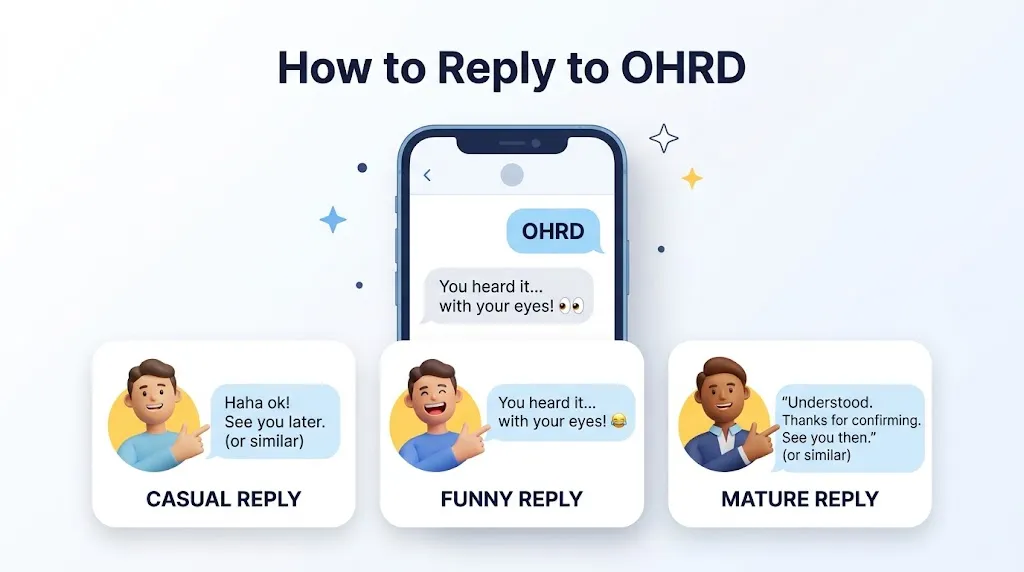
Getting an ohrd back can feel like a conversational dead end, but it doesn’t have to be. How you respond shapes where the chat goes next.
What’s the Best Way to Reply to OHRD?
- Add a follow-up question to keep things moving
- Mirror their energy if the vibe feels light
- Use humor to lighten an otherwise flat exchange
- Ask directly if you’re unsure about their tone
- Don’t panic silence after it doesn’t always mean something’s wrong
Casual Replies
- “ohrd, anyway what time we meeting”
- “ohrd lol okay”
- “bet, ohrd”
Funny Replies
- “ohrd 💀 say less”
- “ohrd… and?”
- “ohrd, thrilling stuff”
Mature / Confident Replies
- “Got it, thanks for letting me know”
- “Understood, I’ll plan around that”
- “Appreciate you telling me”
Private or Respectful Replies
- Ask a gentle clarifying question if the tone felt off
- Give the person space instead of assuming the worst
- Follow up later rather than overreacting in the moment
Why Do People Use OHRD Instead of Full Sentences?
Typing full sentences takes time, and most digital conversations move fast. Ohrd exists because brevity fits how people actually chat today.
- Speed matters more than grammar in casual texting
- Shorter replies keep the conversation flow natural
- It mirrors how people talk out loud quick and reactive
- Full sentences can feel overly formal between close friends
- Efficiency is the whole point of most internet slang
Regional & Cultural Usage
Ohrd isn’t used identically everywhere. Regional habits and cultural texting norms shape how often and how it shows up.
Does OHRD Mean the Same Thing Worldwide?
- Core meaning stays consistent across English-speaking regions
- Frequency of use varies by platform popularity in each region
- Some cultures favor longer acknowledgments over clipped slang
- Global internet slang spreads faster through shared platforms like TikTok
- Local slang often blends with terms like ohrd rather than replacing it
Western Culture
- Extremely common among US and UK younger texting users
- Fits naturally into fast-paced group chat culture
- Often mixed with other Gen Z slang in the same message
Asian Culture
- Used mostly among English-speaking youth on Western-influenced apps
- Less common in native-language texting, more present in English DMs
- Often appears alongside K-pop fandom or gaming chat culture
Middle Eastern Culture
- Appears mainly in English-language social media interactions
- Common among bilingual users switching between languages while texting
- Usage grows with exposure to Western internet slang trends
Global Internet Usage
- Spread largely through shared memes and cross-platform screenshots
- TikTok and Instagram act as the biggest distribution points
- Continues evolving as new variations get created and shared globally
FAQs
What does ohrd mean in a text message?
Ohrd means “oh, heard” a short way to confirm a message was received and understood.
Is ohrd a rude reply?
Not usually. The ohrd meaning in text is neutral; rudeness depends on tone and context, not the word itself.
Where did ohrd come from?
It grew out of casual texting slang, following the same vowel-dropping pattern as other short acknowledgments.
Can ohrd be used at work?
It’s best avoided in professional settings since the ohrd meaning in text reads as too casual for formal chats.
What’s a good reply to ohrd?
Adding a follow-up question or a bit of humor usually keeps the conversation going naturally after an ohrd.
Does ohrd mean someone is upset?
Not necessarily. The ohrd meaning in text is simple acknowledgment assuming anger usually says more about anxiety than intent.
Is ohrd only used by younger people?
Mostly, yes. It’s most common among younger texters, though the ohrd meaning in text has spread across many age groups online.
Conclusion
At the end of the day, the ohrd meaning in text is far less complicated than overthinking it makes it feel. It’s simply “oh, heard” a fast, casual way to confirm a message landed, nothing more dramatic than that. What changes the read is tone, timing, and the relationship behind the screen, not the word itself.
Understanding what does ohrd mean in text helps take the guesswork out of everyday chats, whether it shows up in a group thread or a quiet DM. So next time it lands in your inbox, resist the urge to spiral the ohrd meaning in text is rarely as loaded as it feels. Reply with confidence, match the energy, and keep the conversation moving.
Read more: Hmm Meaning in Text: The Secret Meaning Behind It (2026)

Grace Anderson is an English language writer who shares clear grammar lessons, practical writing tips, and helpful examples for learners.