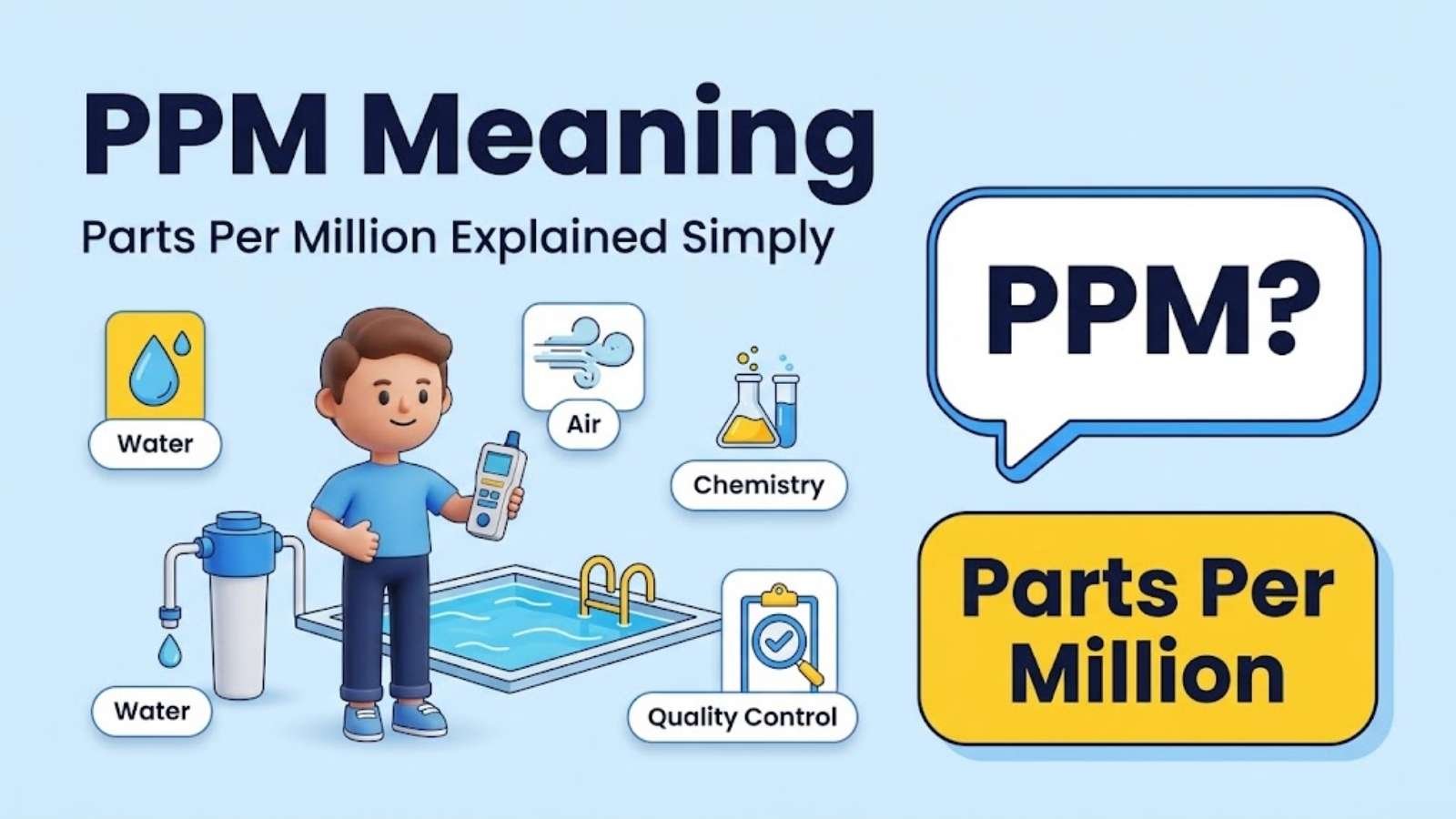
You’ve probably seen the letters PPM on a water filter box, a pool test strip, or in a random work chat, and just nodded along like you totally understood it even though a small part of you was quietly Googling it under the table.
That’s exactly why this guide exists. We’re breaking down the full PPM meaning, the ppm full form, and every real-life way people actually use it from WhatsApp chats to Slack messages. If you come across business terms like SME or BPM in your work conversations, understanding the context can make those confusing abbreviations much easier too. Keep reading, it gets clearer with every section.
PPM Meaning – Quick Explanation
Before the science and the jargon, let’s slow down. PPM meaning sounds technical, but it’s honestly one of the simplest ideas once someone breaks it down without the textbook tone.
What Does PPM Actually Stand For?
- PPM stands for parts per million, a way to measure tiny amounts.
- It shows how much of one thing exists inside one million parts of another.
- Used mostly for concentration like a chemical in water or air.
- One PPM equals one unit out of a million total units.
- It’s a ratio, not a fixed weight or size.
- Common in water testing, air quality, and manufacturing.
- The smaller the number, the more diluted the substance is.
Simple definition
At its core, PPM meaning comes down to one thing: proportion. It tells you how much of something is mixed into a much bigger amount, nothing more dramatic than that.
In plain words
Imagine a swimming pool filled with a million drops of water, and just one drop is red dye. That one red drop is your 1 PPM barely visible, but technically there.
Quick examples
| Example | What It Means |
| 5 PPM chlorine in pool water | 5 units of chlorine per million units of water |
| 400 PPM CO2 in air | 400 molecules of CO2 per million air molecules |
| 10 PPM lead in soil | 10 units of lead per million units of soil |
Example in texting: Friend 1: “My water filter shows 45 ppm, is that bad?” Friend 2: “Nah that’s actually pretty clean, relax 😄”
PPM full form
People search this constantly, so let’s answer it straight with no fluff, no detour, just the real ppm full form and why it matters.
Why the Full Form Confuses So Many People
The ppm full form trips people up because the same three letters get reused across totally different industries, and nobody explains that clearly enough.
- Full form: Parts Per Million.
- It is not an abbreviation for percentage or a brand name.
- Always tied to a ratio of one substance to a million units.
- Sometimes mistaken for “per minute” in unrelated contexts.
- Written as ppm, PPM, or p.p.m. all the same thing.
- Used across science, business, and even project management.
- Knowing the ppm full form helps you read labels and reports correctly.
Example in chat: Friend 1: “What’s ppm full form again, I keep forgetting” Friend 2: “Parts per million, it’s basically a tiny fraction thing”
Origin & Background of PPM
Every unit has a backstory, and the PPM meaning we use today didn’t just appear overnight; it grew out of a real need for precision.
How Scientists Started Measuring in Millions
Long before digital sensors existed, chemists needed a way to describe extremely small concentrations without using clunky decimals or fractions.
- Emerged from early analytical chemistry in the 1800s.
- Created to avoid writing long, awkward decimal fractions.
- Adopted widely once water quality testing became standardized.
- Became a global unit for trace concentration measurement.
- Grew alongside environmental monitoring in the 20th century.
- Standardized further with the rise of digital lab instruments.
- Now embedded in international scientific reporting systems.
Where it started
The concept traces back to chemists needing a practical way to describe dilute solutions, long before modern lab equipment made this kind of precision effortless.
How it evolved
Over decades, PPM shifted from a niche lab term into something environmental scientists, engineers, and even factory managers relied on daily for consistency.
Modern influence
Today the PPM meaning stretches into business too think defect rates, air sensors, and app-based water testers that show live readings on your phone.
Example in texting: Friend 1: “Since when did ppm become such a common word lol” Friend 2: “Since every gadget started showing readings I guess”
Real-Life Conversations Using PPM
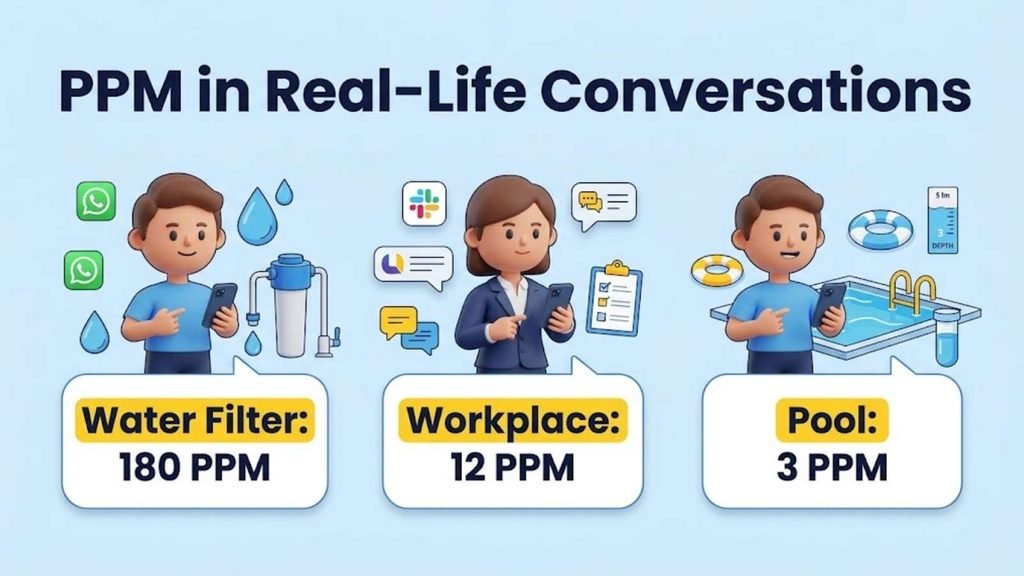
Nothing explains PPM meaning better than seeing it in the wild in actual conversations where people use it casually, without overthinking the science behind it.
How Do People Actually Talk About PPM Day to Day?
- Appears in home maintenance chats about filters and water.
- Shows up in workplace tools tracking quality or defects.
- Common in social media captions about pools and cleaning.
- Often paired with numbers like “low ppm” or “high ppm.”
- Used casually, without always explaining the ppm full form.
- Sometimes shortened further in fast typing, like “ppms.”
- Frequently followed by a question like “is that safe?”
WhatsApp Chat – Home Water Filter
Example in chat: Friend 1: “Tested our tap water, it’s showing 180 ppm” Friend 2: “That’s high, might be time for a new filter”
Workplace Slack Conversation
Example in chat: Colleague 1: “QA flagged the batch, defect rate is at 12 ppm” Colleague 2: “That’s within tolerance, we’re good to ship”
Instagram Comment on a Pool Cleaning Reel
Example in chat: Commenter 1: “What ppm do you keep your chlorine at?” Commenter 2: “Usually around 3 ppm, keeps it balanced”
Emotional & Psychological Meaning of PPM
This might sound surprising, but numbers like PPM carry real emotional weight especially when they’re tied to safety, health, or something people genuinely worry about.
Why a Small Number Can Still Feel Big
People don’t just want the PPM meaning; they want reassurance that whatever they’re measuring water, air, or a product isn’t secretly harmful to them or their family.
- Triggers a sense of control over invisible risks.
- Connected to peace of mind around health and safety.
- Reflects a desire for precision instead of vague guessing.
- Often tied to anxiety about contamination or pollution.
- Used to build trust in products and reports.
- Give people a concrete number instead of “probably fine.”
- Helps turn an abstract worry into something measurable.
Why people care about it
Nobody wants to guess whether their drinking water or air is safe, so a clear PPM number gives people something concrete to hold onto instead of uncertainty.
What mindset it reflects
Caring about PPM often reflects a mindset of wanting evidence over assumption, the same instinct that makes people read ingredient labels or check nutrition facts.
Example in texting: Friend 1: “I get weirdly anxious checking the ppm on my water tester lol” Friend 2: “Same, I just want the number to be low honestly”
Usage of PPM in Different Contexts
The PPM meaning doesn’t stay the same everywhere it quietly shifts depending on who’s using it and what they’re actually measuring at that moment.
Does PPM Mean the Same Thing Everywhere?
- Not exactly the unit stays the same, but the subject changes.
- In science, it usually means chemical concentration.
- In business, it can mean defect or error rate.
- In casual talk, it often refers to water or air quality.
- Context clues almost always reveal which meaning applies.
- Misreading the context is the most common PPM mistake.
- Always check what’s being measured before assuming the meaning.
| Context | What PPM Usually Refers To |
| Water testing | Dissolved minerals or contaminants |
| Air quality | Pollutant or CO2 concentration |
| Manufacturing | Defects per million units produced |
| Chemistry lab | Concentration of a solute |
1. Social Media
On platforms like Instagram, PPM shows up in captions about pool care, skincare ingredients, or water purity usually paired with a quick tip or warning.
2. Friends & Daily Life
Among friends, it’s casual when someone mentions their filter reading or a pool test, and everyone nods without needing a full science lesson.
3. Work & Professional Settings
In offices and factories, PPM often tracks defect rates, following Six Sigma standards where lower numbers mean better quality control.
4. Casual vs Serious Usage
Casual usage is relaxed and quick, while serious usage like environmental compliance treats the same three letters as a legally reportable figure.
Example in chat: Friend 1: “Wait so ppm means different things depending on where you see it?” Friend 2: “Yeah, same math, different subject basically”
What Does a High PPM Number Actually Mean?
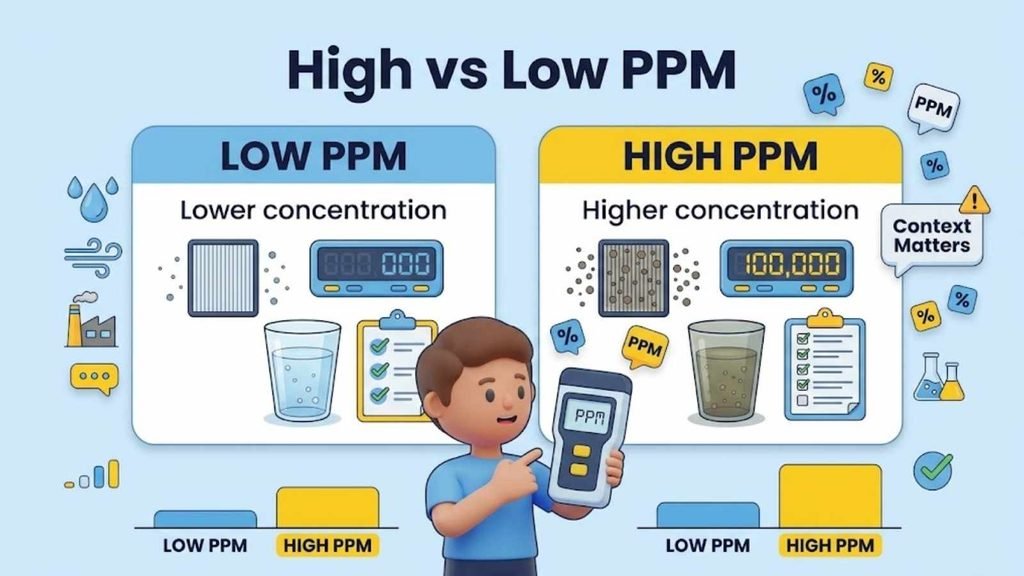
A high number isn’t automatically dangerous, but it does deserve attention. The real answer depends entirely on what’s being measured and where.
- High PPM in chlorine can mean over-treated pool water.
- High PPM in defects signals a quality control problem.
- High PPM in CO2 can indicate poor ventilation.
- Context always decides whether “high” means risky or normal.
- Comparing against safety thresholds is more useful than the raw number.
Example in texting: Friend 1: “My air quality app just said 900 ppm CO2 inside” Friend 2: “Crack a window, that’s a bit stuffy”
Common Misunderstandings About PPM
Even smart, careful people mix up PPM meaning sometimes, usually because the term overlaps with other everyday measurements in confusing ways.
What Do People Get Wrong Most Often?
- Confusing PPM with percentage as if they’re interchangeable.
- Assuming a low number always means completely harmless.
- Using PPM to describe things it was never meant to measure.
- Forgetting that context changes what’s actually being counted.
- Mixing up PPM with PPB (parts per billion) accidentally.
- Believing PPM only applies to water, ignoring air and industry.
- Skipping the ppm full form and guessing instead of confirming.
1. Thinking PPM means percentage
They’re related mathematically, but PPM is far smaller, one percent equals 10,000 PPM, not the same scale at all.
2. Assuming small means harmless
Some substances are dangerous even at very low PPM levels, so “small number” doesn’t automatically translate to “safe.”
3. Using PPM in the wrong context
Applying a chemical PPM reading to something like manufacturing defects, without adjusting the meaning, leads to confusing conversations.
Example in chat: Friend 1: “So 1% is basically the same as 1 ppm right?” Friend 2: “Nope, 1% is actually 10,000 ppm, huge difference”
PPM Comparison Table
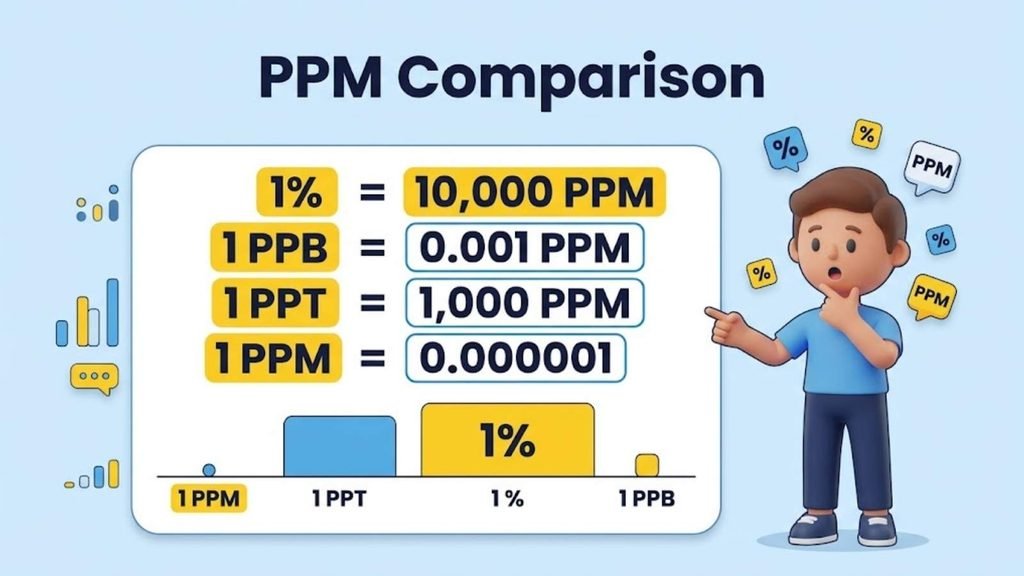
Sometimes a side-by-side view explains the PPM meaning faster than paragraphs ever could here’s a quick reference to keep handy.
| Unit | Equivalent in PPM |
| 1 Percent (%) | 10,000 PPM |
| 1 Part per Billion (PPB) | 0.001 PPM |
| 1 Part per Thousand (PPT) | 1,000 PPM |
| 1 Decimal Fraction | 0.000001 = 1 PPM |
| 1 mg per Liter | Approximately 1 PPM (in water) |
Example in texting: Friend 1: “This table actually made ppm click for me finally” Friend 2: “Right? Seeing it next to percentage helps a lot”
Variations / Types of PPM (Common Uses)
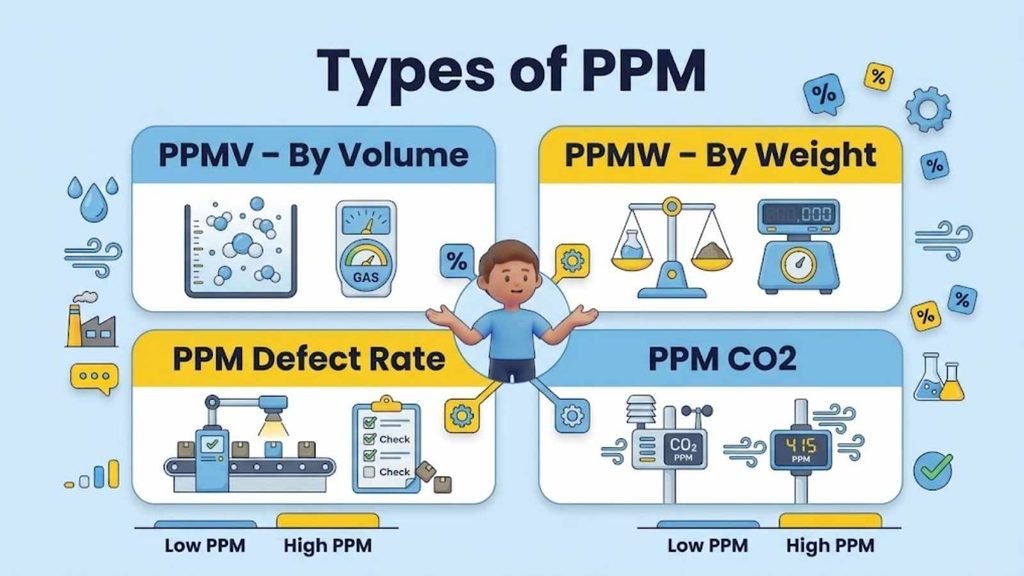
The PPM meaning branches into a few recognizable types depending on the industry knowing these helps you understand any report at a glance.
- PPMV parts per million by volume, used for gases.
- PPMW parts per million by weight, used for solids or liquids.
- PPM defect rate used in manufacturing quality tracking.
- PPM chlorine level common in pools and drinking water.
- PPM CO2 tracked for indoor and outdoor air quality.
- PPM hardness used to describe mineral content in water.
- PPM temperature coefficient used in electronics and engineering.
Example in chat: Friend 1: “Didn’t know ppm had different types honestly” Friend 2: “Yeah it changes based on whether it’s gas, liquid, or solid”
Why Do Different Industries Use PPM Differently?
Every industry borrows the same unit but bends it toward its own priorities: safety, quality, or performance which is why the number “feels” different depending on where you see it.
- Environmental science focuses on pollutant thresholds.
- Manufacturing focuses on minimizing defective products.
- Water treatment focuses on mineral and contaminant balance.
- Electronics focuses on component stability and accuracy.
- Each field sets its own acceptable PPM range.
Example in texting: Friend 1: “Why does 5 ppm sound fine in water but scary in air?” Friend 2: “Different substances, different safety limits basically”
How to Respond When Someone Uses “PPM”
If someone drops PPM into a conversation and you’re unsure what to say back, here are a few natural, low-pressure ways to reply without overthinking it.
What’s a Natural Way to Reply to a PPM Mention?
- Ask “is that considered high or low?” to keep it simple.
- Say “good to know, thanks for checking” if it’s informational.
- Offer a quick comparison if you know a similar reading.
- Keep tone casual, since most PPM chat is low-stakes.
- Use humor if the context feels light and non-serious.
- Stay respectful if it’s a professional or safety-related chat.
- Avoid overexplaining the ppm full form unless someone asks.
Casual Replies
“Oh nice, is that good or should I be worried?” keeps things light and shows you’re engaged without needing a science degree.
Funny Replies
“My brain just read that as ‘pretty please, measure!'” works well in relaxed group chats where nobody’s taking it too seriously.
Mature & Confident Replies
“That’s within normal range, no action needed right now” shows you understand the context and can respond with quiet confidence.
Private or Respectful Replies
In sensitive settings, like health-related water testing, a simple “thanks for flagging this, let’s monitor it” keeps things calm and considerate.
Example in chat: Friend 1: “Ppm just came back at 22, thoughts?” Friend 2: “That’s totally normal, nothing to stress about”
Is a Low PPM Always Safe?
Not necessarily a low reading is reassuring, but it’s not an automatic green light, especially with substances that are harmful even in tiny amounts.
- Some chemicals have strict low-PPM safety limits.
- “Low” is relative to what’s actually being measured.
- Regulatory bodies set specific thresholds per substance.
- Always compare against an official safety standard, not instinct.
- When unsure, a professional test gives more clarity than guessing.
Example in texting: Friend 1: “It’s only 2 ppm though, that’s basically nothing right?” Friend 2: “Depends what it is, some stuff is risky even that low”
Regional & Cultural Usage of PPM
The PPM meaning stays scientifically consistent worldwide, but how casually or seriously people talk about it shifts a lot depending on region and culture.
How Differently Do Regions Talk About PPM?
- Western regions often discuss it around water filters and air apps.
- Asian regions frequently reference it in manufacturing quality control.
- Middle Eastern regions tie it closely to desalinated water quality.
- Global internet culture treats it casually across comment sections.
- Regulatory strictness around PPM varies by country and industry.
Western Culture
In the US and Europe, PPM conversations often center on drinking water safety, indoor air quality apps, and environmental compliance reports.
Asian Culture
Across manufacturing hubs in Asia, PPM is an everyday quality metric, closely tied to Six Sigma practices and factory performance tracking.
Middle Eastern Culture
In regions relying heavily on desalination, PPM readings for salinity and mineral content are a regular part of public water discussions.
Global Internet Usage
Online, PPM shows up casually in comment sections, DIY videos, and product reviews, often stripped of technical explanation entirely.
Example in chat: Friend 1: “Is ppm talked about the same everywhere?” Friend 2: “Same meaning, just different everyday focus depending on the place”
FAQs About PPM Meaning
1. What does PPM actually stand for?
PPM stands for parts per million, showing one unit of something within a million total units of a mixture.
2. Is PPM the same as percentage?
No, PPM is much smaller than percentage one percent equals 10,000 units of PPM, so they’re not interchangeable.
3. What is considered a high PPM level in water?
It depends on the substance, but generally above 300–500 PPM total dissolved solids is considered noticeably high for drinking water.
4. Why do companies use PPM for defect rates?
Companies use PPM because it expresses extremely small error rates precisely, which matters in large-scale manufacturing quality control.
5. Can PPM be converted to milligrams per liter?
Yes, for water-based solutions, PPM and milligrams per liter are roughly equivalent, making conversions simple in most cases.
6. Does a low PPM always mean something is safe?
Not always some substances remain risky even at very low PPM, so context and official thresholds matter more than the number alone.
7. Where is PPM most commonly used?
PPM is most commonly used in water testing, air quality monitoring, chemistry, and manufacturing quality control worldwide.
Conclusion
At the end of the day, the PPM meaning isn’t as intimidating as it first looks. It’s simply a way of showing how much of something exists inside a much bigger picture whether that’s chlorine in your pool, minerals in your tap water, or defects on a factory line. Once you understand the ppm full form, parts per million, the rest naturally falls into place.
The PPM meaning shows up more often than people realize, quietly shaping decisions about safety, quality, and trust. Next time you spot PPM on a label, a chat, or a report, you won’t just skim past it, you’ll actually understand exactly what it’s telling you, and that’s a genuinely useful thing to carry forward.

Grace Anderson is an English language writer who shares clear grammar lessons, practical writing tips, and helpful examples for learners.