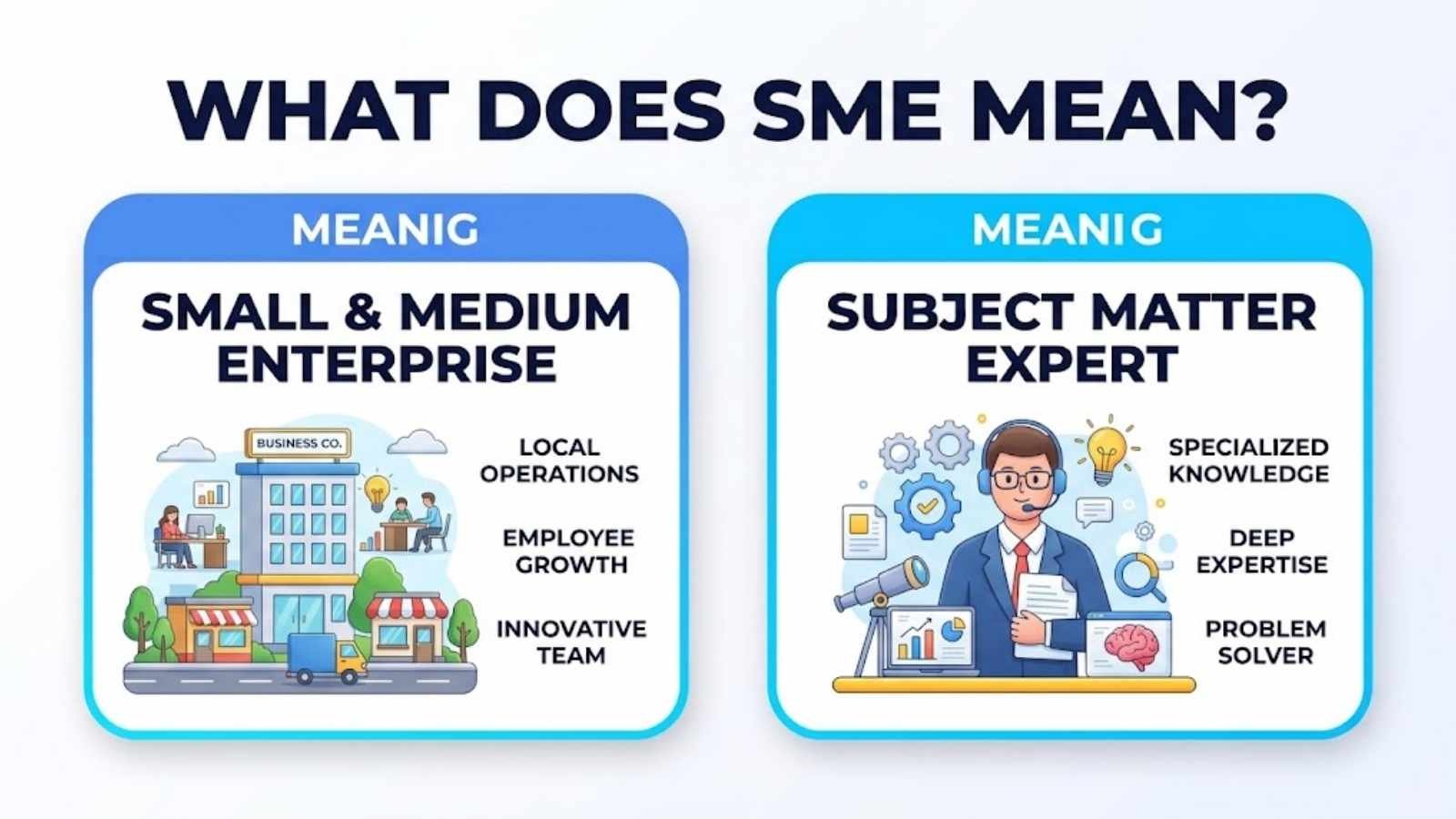
You saw “SME” in a work email, a LinkedIn post, or a group chat, and your brain just blanked. You’re not alone, almost everyone has stared at three random letters wondering if they missed a memo. That tiny flash of confusion is exactly why this guide exists.
By the end of this article, you’ll know exactly what does SME mean, how it shifts between business and expert contexts, and how to use it confidently in real conversations. We’ll cover sme meaning employee situations, real chat examples, regional differences, and every variation you’ll ever run into. Keep reading, the answer is simpler than you think.
SME – Quick Meaning
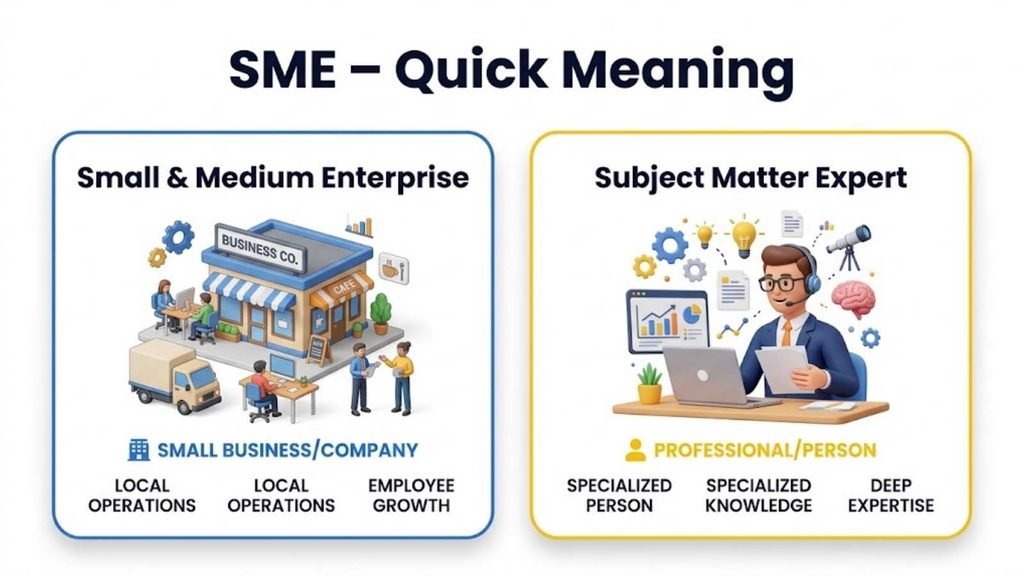
Most people freeze the first time they see “SME” because it quietly means two completely different things depending on where you read it. SME stands for either Small and Medium Enterprise or Subject Matter Expert, and the context tells you which one you’re dealing with.
How Is SME Used in Everyday Conversations?
- Business use: SME usually refers to a small or medium-sized company.
- Professional use: SME refers to a person who is a specialist in one topic.
- Emails: managers write “loop in the SME” meaning the expert, not the company.
- Reports: government and finance papers use SME for business classification.
- Casual chats: younger professionals now use SME loosely for “the person who knows.”
Example in chat: Friend 1: “Wait, is our company an SME?” Friend 2: “Yeah, under 250 employees, we count as an SME.”
Business Meaning
The business meaning of SME describes Small and Medium-sized Enterprises companies that stay under a set number of employees and a set revenue ceiling. This definition powers policy, funding, and tax rules worldwide.
- SMEs typically employ fewer than 250 people.
- Annual turnover usually stays under €50 million in the EU model.
- Governments treat SMEs as the backbone of local economies.
- Banks offer special SME loan products with easier terms.
- Most private companies globally actually qualify as an SME.
Professional Meaning
In workplaces, SME almost always points to a Subject Matter Expert, the go-to person for one specific skill or process. This use has nothing to do with company size.
- An SME is the most knowledgeable person on a topic.
- Companies bring in SMEs for training and documentation.
- SMEs review work for technical accuracy.
- Project teams treat an SME as a trusted resource.
- The title is earned through experience, not a job level.
Quoted Examples
- “Our SME confirmed the process meets compliance standards.”
- “She’s the SME for the new onboarding software.”
- “As an SME, small businesses like ours qualify for the grant.”
- “We need an SME, meaning an employee who owns the whole workflow.”
| Context | What SME Means | Typical Users |
| Business/Finance | Small and Medium Enterprise | Banks, governments, investors |
| Workplace/Training | Subject Matter Expert | Managers, HR, project teams |
| Casual chat | Either depends on topic | Coworkers, students |
SME Meaning Employee
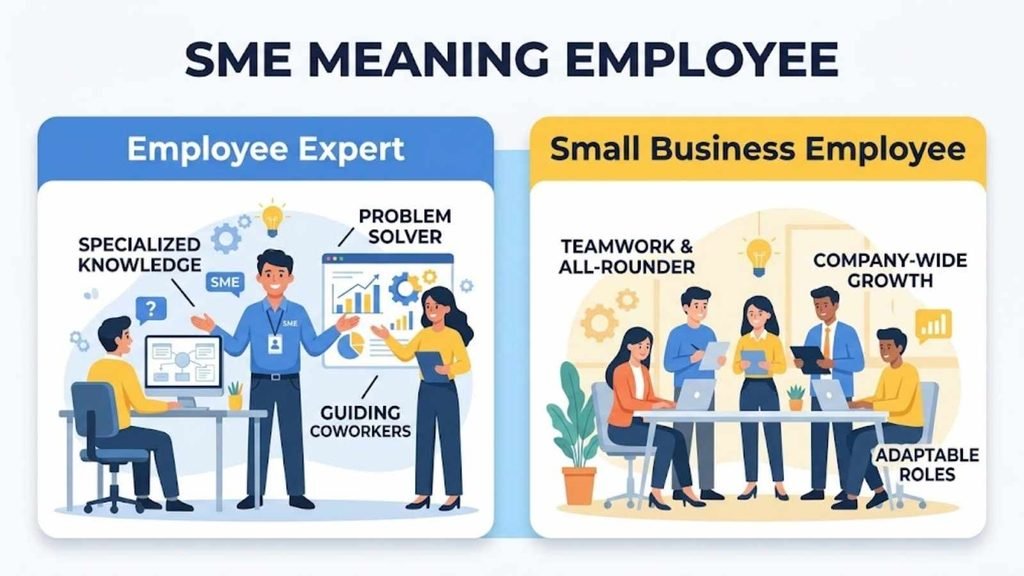
When people search sme meaning employee, they’re usually asking one of two things: is this person a small-business employee, or is this employee the designated in-house expert? Both readings are common, and the surrounding sentence usually settles it.
- An SME employee can mean staff working at a small business.
- It can also mean an employee named the internal expert.
- HR teams often label someone the “resident SME” for a skill.
- Job listings sometimes ask for “SME experience” meaning expert-level knowledge.
- Confusion here is common, so context always decides the meaning.
Example in texting: Friend 1: “The new hire is our SME for payroll now.” Friend 2: “Oh nice, so she’s the go-to employee for that stuff.”
Origin & Background
Every acronym has a story, and SME’s dual identity comes from two completely separate professional worlds that happened to shrink down to the same three letters.
Business Context Origin
The business sense of SME grew out of economic policy language in the 20th century, used to separate small companies from large corporations for funding, tax, and regulatory purposes.
- The term spread through EU and UN economic reports.
- Governments needed a way to support smaller businesses specifically.
- Employee count and revenue became the standard measuring sticks.
- The label helps businesses access grants and reduce taxes.
- Usage became global once trade organizations adopted it.
Professional Context Origin
The expert meaning of SME began in corporate training and technical industries, where teams needed a quick label for “the person who actually knows this stuff.”
- IT and engineering fields popularized the expert usage early.
- Instructional design made SME a standard training term.
- Corporate documentation still leans on SMEs for accuracy checks.
- The label spread into HR and project management language.
- Today it’s common in almost every industry.
Real-Life Conversations
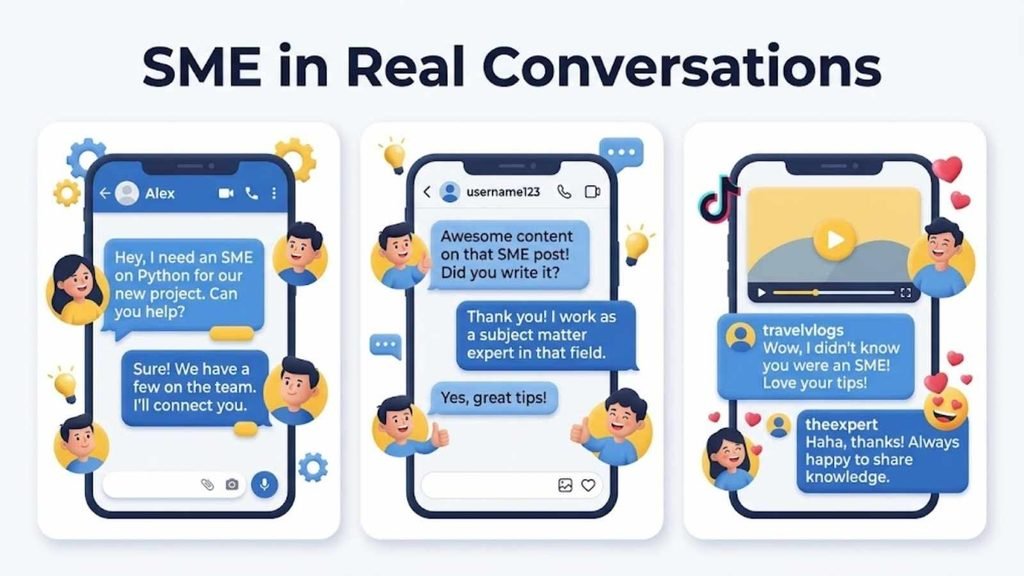
Seeing SME used in real conversations makes the meaning click faster than any definition ever could. Here’s how it actually shows up online.
WhatsApp Chat (Startup Founders)
- Founders use SME to talk about funding eligibility.
- The term signals company size in investor chats.
- It’s shorthand for “we’re not a big corporation yet.”
- Founders compare SME grants across regions.
- The tone stays casual but informed.
Example in chat: Friend 1: “Did you apply for the SME relief fund?” Friend 2: “Yep, we qualify since we’re under 50 staff.”
Instagram DM (Career Discussion)
- People discuss becoming an SME in their career.
- It signals expertise, not job title.
- Users ask how to be seen as the SME at work.
- The term boosts personal branding on LinkedIn crossposts.
- Confidence comes from being a known expert.
Example in chat: Friend 1: “I finally got called the team SME in the meeting.” Friend 2: “That’s huge, means they trust your expertise fully.”
TikTok Comments (Business Content)
- Commenters use SME to describe small business struggles.
- Creators explain SME meaning in captions for clarity.
- Viewers relate SME content to their own side hustle.
- The term trends during small business awareness content.
- Comments often ask, “what does SME mean in this video?”
Example in chat: Friend 1: “This creator keeps saying SME, what is that?” Friend 2: “Small and medium enterprise, basically small biz owners.”
Emotional & Psychological Meaning
Beyond the dictionary definition, SME carries real emotional weight, pride for business owners, and validation for professionals.
When Referring to Businesses
- Being an SME can feel like the underdog identity.
- Owners feel pride in building something small but real.
- SME status brings anxiety around funding and survival.
- The label offers a sense of community with peers.
- It reminds owners they’re not alone in the struggle.
When Referring to Experts
- Being called an SME feels like recognition.
- It builds confidence in one’s professional identity.
- Some feel pressure to always have the right answer.
- The title can bring job security and respect.
- It often becomes part of someone’s personal brand.
Usage in Different Contexts
SME shifts tone depending on where you see it. A formal report reads very differently from a group chat joke.
Social Media
- Creators use SME to describe small business content.
- Hashtags like #SME trend around entrepreneurship.
- Comment sections ask for quick definitions.
- Business pages tag themselves as a proud SME.
- The term boosts relatability with small audiences.
Friends & Relationships
- Friends jokingly call someone the SME of a hobby.
- It’s used playfully for the “expert friend” in a group.
- Rarely used for the business meaning casually.
- Adds a light, teasing tone between friends.
- Shows appreciation for someone’s niche knowledge.
Work & Professional Settings
- Managers formally assign an SME to a project.
- Reports classify companies as an SME for funding.
- Meetings often say “check with the SME” first.
- HR documents use SME meaning employee expert.
- The tone stays professional and precise.
Casual vs Serious Tone
| Setting | Tone | Common Meaning |
| Group chat | Playful | Expert friend |
| Business report | Formal | Small/medium company |
| Office meeting | Professional | Subject matter expert |
| Social media caption | Relatable | Small business owner |
What Does SME Really Mean in a Job Description?
Job listings rarely explain themselves, and seeing SME on a posting can leave applicants guessing whether they need business or expert-level experience.
- SME on a job post usually means specialist experience.
- It signals that the role needs deep technical knowledge.
- Some listings mean SME industry experience instead.
- Read the surrounding duties to confirm the meaning.
- HR uses SME meaning employee for the expert hire.
Why Do People Confuse SME With Other Acronyms?
Confusion happens because SME overlaps visually and contextually with other short business or workplace acronyms people see daily.
- SME gets mixed up with SMB (small and medium business).
- People confuse it with SEO due to similar letters.
- Some assume SME always means startup.
- Others confuse SME with a general manager title.
- Context clues almost always resolve the mix-up.
Common Misunderstandings
Thinking SME Means Only Business
- Many assume SME is exclusively a company term.
- This ignores the huge expert usage in workplaces.
- The mistake happens most in casual reading.
- Context words like “consult” hint at the expert meaning.
- Both meanings are equally valid and common.
Confusing It With Freelancer
- SME experts aren’t automatically freelancers.
- Many SMEs are full-time employees.
- Freelancers can also become SMEs in their niche.
- The terms describe different things entirely.
- One is a role, the other is a status.
Assuming SME = Startup
- SMEs are not always startups.
- Many SMEs have operated for decades.
- Startups are usually early-stage, SMEs are size-based.
- A startup can grow into an SME.
- The size threshold, not age, defines an SME.
Using It Casually in Formal Reports
- Casual SME usage feels out of place formally.
- Reports should specify the exact meaning upfront.
- Mixing meanings can cause real miscommunication.
- Always define SME on first use in documents.
- Clarity avoids costly misunderstandings.
Comparison Table
| Term | Full Meaning | Refers To | Common Setting |
| SME (business) | Small and Medium Enterprise | A company | Finance, policy, banking |
| SME (expert) | Subject Matter Expert | A person | Workplace, training |
| SMB | Small and Medium Business | A company | US business contexts |
| Freelancer | Independent contractor | A person | Gig economy |
Variations / Types of SME (8–10 Minimum)
SME isn’t one-size-fits-all both the business and expert versions branch into recognizable subtypes people search for constantly.
Micro SME
- Fewest employees, usually under 10.
- Often a solo or family-run operation.
- Common in local retail and services.
- Qualifies for the smallest funding tier.
- Very flexible but limited resources.
Local SME
- Serves a specific town or region.
- Builds strong community trust.
- Competes on relationships, not scale.
- Often family-owned for generations.
- Relies heavily on word of mouth.
Digital SME
- Operates mainly online.
- Uses e-commerce and digital tools.
- Lower overhead than physical stores.
- Scales faster through digital marketing.
- Common in modern startups.
Manufacturing SME
- Produces physical goods.
- Needs equipment and supply chains.
- Often supplies larger corporations.
- Faces higher capital costs.
- Vital to industrial economies.
Service SME
- Sells expertise or labor, not products.
- Includes agencies, consultants, and trades.
- Lower startup costs typically.
- Growth depends on reputation.
- Very common SME category globally.
Financial SME
- Specializes in money and accounting knowledge.
- Acts as the expert for audits.
- Guides companies on compliance.
- Trusted for risk assessment.
- Often holds formal certifications.
Technical SME
- Expert in software or engineering.
- Supports product development teams.
- Solves complex technical problems.
- Often trains junior staff.
- Central to tech companies.
Compliance SME
- Ensures rules and regulations are followed.
- Review processes for legal risk.
- Common in healthcare and finance.
- Prevents costly violations.
- Works closely with legal teams.
Training SME
- Designs and reviews learning content.
- Ensures materials stay accurate.
- Partners with instructional designers.
- Bridges knowledge gaps in teams.
- Key to employee development.
Operational SME
- Understands day-to-day processes deeply.
- Improves efficiency on the ground.
- Often a long-tenured employee.
- Trusted for workflow decisions.
- Keeps operations running smoothly.
When Should You Use SME in a Conversation?
Knowing when to drop SME into conversation keeps you sounding sharp instead of confusing everyone around you.
- Use it when discussing company size for funding or policy.
- Use it when naming the go-to expert on a team.
- Avoid it in casual chats without context.
- Clarify the meaning if the audience seems unfamiliar.
- Skip it in writing meant for a general audience.
How to Respond When Someone Uses It
Casual Replies
- “Oh nice, so you’re the SME here?”
- “Got it, small business SME then.”
- “Makes sense, you’d be the expert on that.”
- “SME as in company or person?”
- “That’s a fun way to say expert.”
Funny Replies
- “SME, sounds fancy for ‘the person who knows.'”
- “So basically you’re the office wizard.”
- “SME or just really good at googling?”
- “Congrats on your new title, expert.”
- “Is there a cape that comes with SME status?”
Mature / Confident Replies
- “Yes, I’m the designated SME for this project.”
- “As the SME, I’ll review it first.”
- “That falls under my expertise as a SME.”
- “I’ll confirm with our SME before deciding.”
- “Being an SME means owning this outcome.”
If Referring to Expert Meaning
- “I’m the SME for onboarding, happy to help.”
- “Ask our SME, she knows this inside out.”
- “I’ve been the team’s SME for two years.”
- “SME status came after years of hands-on work.”
- “I take the SME role seriously.”
Private / Respectful Replies
- “Thank you for trusting me as the SME.”
- “I appreciate being seen as the team’s expert.”
- “I’ll keep supporting the team as SME.”
- “Happy to guide others in this SME role.”
- “Being an SME is a responsibility I value.”
What Industries Rely Most on SMEs?
Some industries lean on both meanings of SME more heavily than others, making the term almost unavoidable in daily work.
- Healthcare depends on compliance and clinical SMEs.
- Finance relies on SMEs for audits and risk.
- Tech needs SMEs for product and engineering accuracy.
- Manufacturing SMEs make up huge portions of supply chains.
- Education leans on SMEs to build accurate curriculum.
Regional & Cultural Usage
Western Culture
- SME commonly means small business in policy talk.
- Workplaces also use it for expert roles freely.
- The term appears often in news and finance.
- Casual use is growing on social platforms.
- Widely understood across US and UK business circles.
Asian Culture
- SMEs are seen as economic pillars in many countries.
- Governments offer strong SME support programs.
- The expert meaning is common in corporate Japan and India.
- SME status carries real national pride.
- Growth of SMEs ties closely to local development.
Middle Eastern Culture
- SMEs are central to economic diversification plans.
- Governments actively fund SME growth initiatives.
- The term appears in Gulf business news constantly.
- Family-run SMEs remain deeply culturally significant.
- Expert-meaning usage is common in oil and tech sectors.
Global Internet Usage
- SME trends globally in LinkedIn and business content.
- TikTok and Instagram simplify SME for general audiences.
- Google searches for “what does SME mean” spike often.
- The term crosses language and industry barriers easily.
- Online use blends both business and expert meanings.
FAQs
What does SME mean in texting?
In texting, SME usually means the person who’s the go-to expert on a topic being discussed casually.
What does SME mean in business?
In business, SME stands for Small and Medium Enterprise, a company under set employee and revenue limits.
What is the sme meaning in employee context?
The sme meaning employee usually refers to staff recognized as the internal expert on a process or skill.
Is SME the same as SMB?
Not exactly SME and SMB both describe small companies, but SMB is more common in American English.
Can one person be an SME and work at an SME?
Yes, someone can be an SME expert while also being employed at a small SME business.
Why do companies use the term SME so much?
Companies use SME because it quickly labels either company size or expert status without extra explanation.
How do I know which SME meaning is being used?
Check the surrounding words funding or size talk means business, while tasks or reviews mean SME expert.
Conclusion
At the end of the day, SME isn’t as confusing as it first looks once you know the context. Whether someone means Small and Medium Enterprise or a Subject Matter Expert, the surrounding conversation almost always makes the SME meaning obvious. We’ve covered the sme meaning, employee angle, real chat examples, regional differences, and every common mix-up people run into.
Next time you see SME pop up in an email, a caption, or a group chat, you won’t freeze. You’ll already know exactly what does SME mean in that moment. Understanding both sides of this acronym isn’t just trivia, it’s a small but real confidence boost in how you read and respond at work and online. Keep this guide handy, and you’ll never second-guess an SME mention again.
Read more: BPM Meaning: The Real Truth You Need to Know (2026)

Grace Anderson is an English language writer who shares clear grammar lessons, practical writing tips, and helpful examples for learners.






1 thought on “What Does SME Mean? The Real Meaning Revealed 2026”